
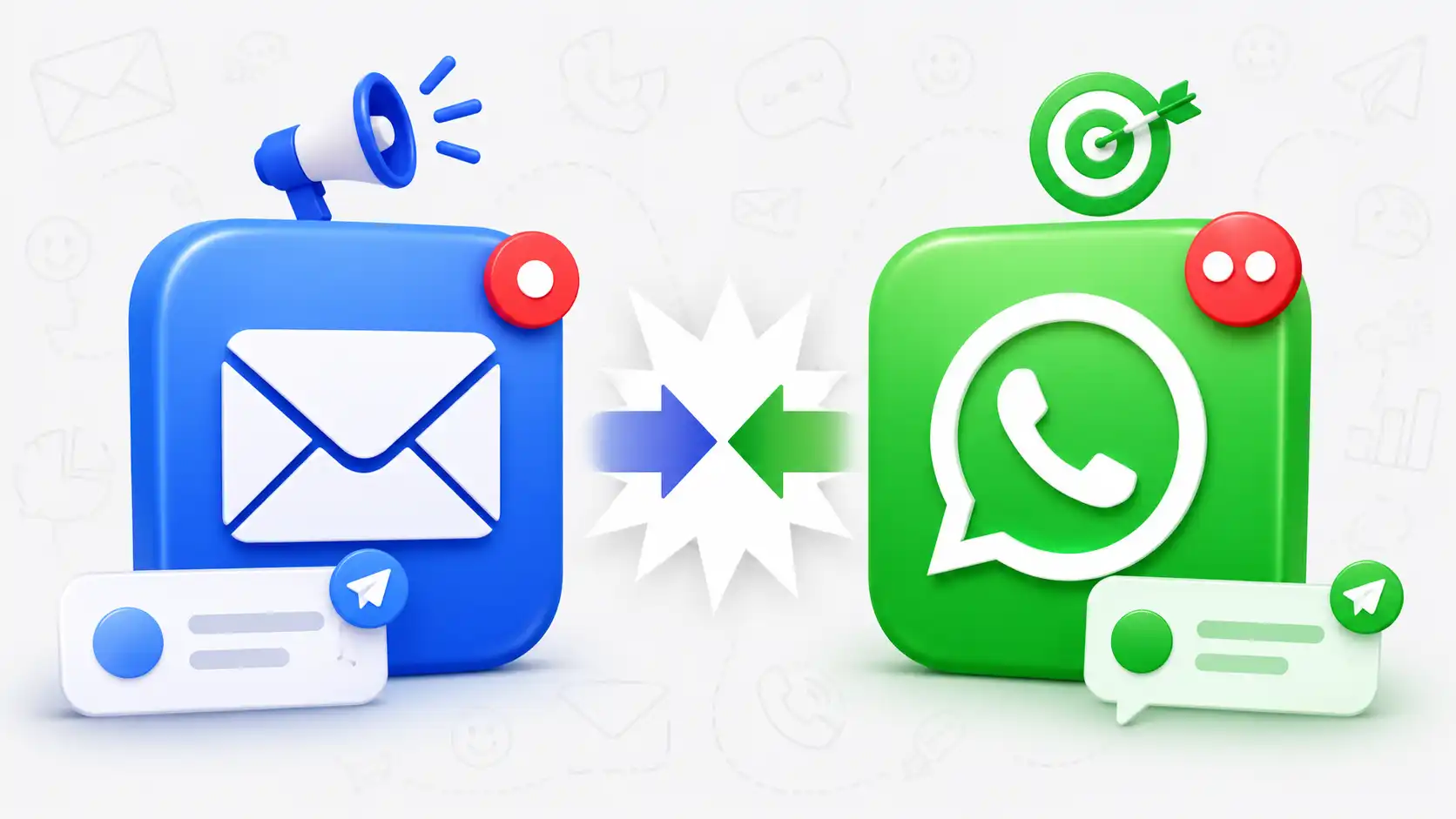
WhatsApp marketing vs email marketing: what works best today?
Every time a new client says yes, a race begins. The faster and more smoothly your business gets them set up, the more confident they feel about their decision. But for most UK small businesses, the client onboarding process is a tangle of manual emails, chased signatures, forgotten follow-ups, and missed leads that quietly fall through the cracks.
Automating your client onboarding changes all of that. Done properly, it means a new lead enters your system and — without anyone lifting a finger — receives a welcome email, gets a contract to sign, books their first call, and is added to your CRM, all within minutes. This guide walks through exactly how to set that up and why it matters so much for growth.
Understanding the difference: WhatsApp marketing vs email marketing
The problem is not that businesses do not care about new clients. The problem is that the client onboarding process is almost entirely admin-heavy, and admin is the first thing that suffers when things get busy.
When you are small, you can get away with handling everything manually. You send welcome emails yourself, follow up on unsigned contracts personally, and keep track of what is needed in your head or on a spreadsheet. But as soon as you start to grow, that approach collapses quickly.
Some of the most common failure points are:
- Leads who enquire but never receive a timely response, so they go elsewhere
- New clients who are left waiting days for a contract or welcome information
- Important intake details that get lost in email threads rather than stored properly
- Kickoff calls that are difficult to schedule because of back-and-forth availability checking
- No consistent experience — some clients get a thorough onboarding, others barely hear from you
Each of these problems has a simple solution: automation. The goal is to build a system that runs the entire client onboarding process for you, so every client gets the same professional, timely experience regardless of how busy you are.
WhatsApp business messaging: speed, visibility, and conversion
WhatsApp has transformed from a personal chat app into one of the most effective business communication tools available. With over 2 billion active users globally, and the UK among its most engaged markets, it has become an expected communication channel for many customers — particularly in service-based industries.
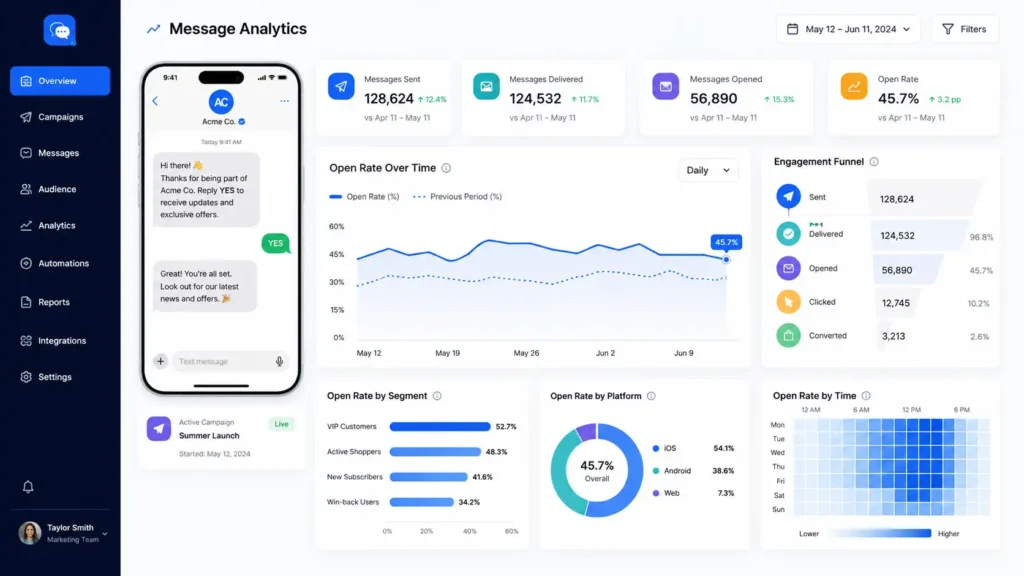
The headline figures are striking. WhatsApp messages consistently see open rates of around 98 per cent, compared to the 20 to 30 per cent typical of email. Messages are usually opened within minutes of delivery. For a business sending an appointment reminder, a time-sensitive offer, or a follow-up to a fresh enquiry, that speed and visibility is enormously valuable.
WhatsApp business messaging also supports two-way conversation in a way that email simply cannot replicate at scale. When a customer replies to a WhatsApp message, a real-time exchange can follow — questions answered, objections handled, bookings confirmed — without either party having to switch platform. This conversational dynamic is particularly powerful at the point of conversion, when a customer is close to making a decision and needs a quick, reassuring response to act.
The strongest use cases for WhatsApp in a business context include appointment reminders and booking confirmations, lead follow-ups after enquiry form submissions, time-limited offers or flash promotions, order and delivery updates, and re-engagement messages for customers who have gone quiet.
Fixxable’s WhatsApp and SMS marketing tools are built around exactly this kind of high-impact messaging — enabling UK businesses to send automated WhatsApp campaigns and two-way messages directly from their CRM, with full contact history and conversation tracking in one place.
Email marketing automation: depth, scale, and long-term relationship building
Despite the noise around newer messaging channels, email marketing remains one of the highest-returning communication strategies available to businesses of any size. It is less intrusive than WhatsApp — emails wait in an inbox rather than demanding immediate attention — which makes them better suited for longer-form content that rewards considered reading.
Where email marketing really earns its place is in nurturing leads across a longer decision-making journey. Not every prospect is ready to buy on the day they first make contact. A structured email sequence can introduce your business, demonstrate expertise, share testimonials, answer common questions, and deliver relevant offers — all automatically, timed to the behaviour of each individual subscriber. That kind of sustained, personalised communication over days or weeks is something WhatsApp is not designed for.
Email marketing automation is also the stronger tool for detailed segmentation. Leading platforms allow businesses to target contacts based on purchase history, engagement behaviour, lifecycle stage, location, and dozens of other criteria — sending each segment content that is genuinely relevant to where they are in the relationship. This level of granularity is harder to achieve through WhatsApp, where the conversational format and template approval requirements limit how complex a workflow can be.
The strongest use cases for email in a business context include welcome and onboarding sequences for new subscribers or customers, newsletters with curated content, educational or informational series, product launches and detailed promotions, loyalty programme updates, and B2B communications that require a more formal, structured format.
For businesses ready to move beyond basic broadcast emails into genuinely intelligent automation, Fixxable’s email marketing automation delivers trigger-based workflows, AI-assisted email templates, and full two-way messaging — all connected to the same CRM that manages your WhatsApp conversations.
Open rates, click-through rates, and what the numbers really mean
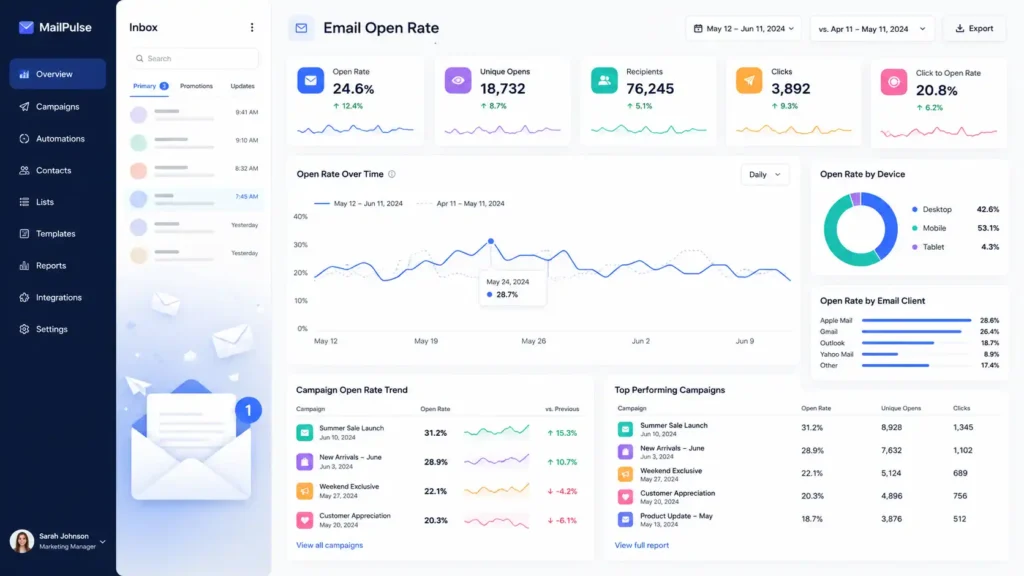
It is easy to look at WhatsApp’s 98 per cent open rate and assume it is the clear winner. But open rates alone do not tell the full story. A message that is opened immediately and acted on is only more valuable than an email if the action you are asking for suits the channel.
WhatsApp click-through rates can be strong — particularly when a message carries a single, clear call to action such as confirming a booking or claiming an offer. But WhatsApp messages are limited in their ability to carry complex information, multiple links, or rich content layouts. If a customer needs to weigh up options, compare products, or absorb detailed information before deciding, an email gives them the space to do that at their own pace.
Email open rates of 20 to 30 per cent look modest alongside WhatsApp, but the absolute numbers can be significant at scale, and the depth of engagement tends to be higher. A customer who opens an email and reads it for two minutes has absorbed far more than one who opened a WhatsApp message and tapped a button. Both interactions have value — they just serve different purposes in the customer relationship.
The most useful metric is not open rate or click-through rate in isolation — it is what action each channel drives, and at what stage of the customer journey. Judging both channels against the same performance measure misses the point.
Still managing WhatsApp and email in separate tools?
Bring your WhatsApp business messaging, email marketing automation, SMS follow-ups, and customer history into one connected CRM — so your team can send faster, more relevant messages without losing track of conversations.
GDPR, consent, and compliance for UK businesses
Both channels are subject to GDPR in the UK, and both require clear consent before you can use them for marketing. But the consent requirements differ in important ways, and treating them as the same can create serious compliance risks.
For email marketing, GDPR requires an explicit, unambiguous opt-in — a pre-ticked box or implied consent does not meet the standard. Subscribers must understand what they are signing up to, and you must provide a straightforward way to unsubscribe. Your email platform should maintain suppression lists and consent records automatically.
WhatsApp adds a further layer. Meta requires that opt-ins for WhatsApp business messaging are collected outside of WhatsApp itself — typically through a website form or checkout flow — and that the opt-in clearly states the contact will receive WhatsApp messages from your business. Outbound marketing messages must use pre-approved templates. Failing to meet Meta’s standards can result in your WhatsApp Business account being restricted, which is a significant operational risk for any business that has built a communication workflow around the channel.
The practical takeaway is to build separate, documented consent flows for each channel — and to keep your consent records stored and accessible. A platform that manages both channels from a single system makes this considerably easier.
The smartest approach: using both channels together
The businesses that get the best results from their communications are not choosing between WhatsApp and email. They are using both deliberately — each channel doing what it does best, at the right moment in the customer journey.
A practical framework for combining both channels looks something like this. In the early stages, when a new lead first makes contact or subscribes, email is the right tool — it introduces the business, provides useful content, and builds trust without feeling intrusive. As the lead engages and moves closer to making a decision, WhatsApp becomes more valuable — enabling fast follow-ups, answering specific questions, and completing the conversion through real-time conversation. After a customer has been won, both channels continue to serve different roles: email for ongoing nurturing, loyalty content, and detailed updates; WhatsApp for quick check-ins, reminders, and time-sensitive communications.
The key condition for this approach to work well is that both channels share the same customer data. If your WhatsApp messages and email campaigns are operating from separate contact lists with no shared logic, you risk sending duplicate or contradictory messages, losing the thread of a conversation, or failing to tailor communications to what a contact has already received. A CRM that connects both channels solves this.
Fixxable’s CRM system is designed to bring all customer communication — WhatsApp, email, SMS, and voice — into a single contact record, giving every team member a complete view of each customer’s history across every channel. That shared data layer is what makes a combined WhatsApp and email strategy actually coherent rather than just two separate campaigns running in parallel.
Common mistakes to avoid with both channels
Several errors consistently undermine both WhatsApp and email marketing efforts — and they are worth naming directly.
Over-messaging on WhatsApp is perhaps the most damaging. Because WhatsApp feels personal, sending too frequently or without genuine relevance feels intrusive in a way that a busy email inbox does not. Contacts who feel bombarded will block your number, which removes them from the channel permanently and can also damage your WhatsApp Business account’s quality rating if it happens at scale.
Neglecting segmentation is another common failure. Sending the same message to your entire contact list — regardless of where each person is in their journey, what they have bought, or what they have previously engaged with — produces weak results on both channels. Generic communication performs poorly compared to well-targeted, relevant messaging.
Treating email as a broadcast-only tool is also a missed opportunity. The best email marketing automation responds to what contacts do — opening, clicking, visiting a page, making a purchase — and adjusts the next message accordingly. Static, scheduled newsletters that ignore contact behaviour leave significant engagement on the table.
Tracking how each message performs is essential for improving both channels over time. Fixxable’s tracking and analytics dashboard shows open rates, click-throughs, and campaign performance across all channels in one view — making it straightforward to identify what is working and where to adjust.
Which channel should you start with?
If you are building your communication strategy from scratch, start with email. It is the more established channel, has broader tooling, and the barrier to entry is lower. A solid email programme with good segmentation and automated workflows gives you a strong foundation — and the contact data it builds can be used to inform your WhatsApp strategy when you are ready to add it.
If your audience is mobile-first, your messages are primarily time-sensitive, and the nature of your business involves real-time conversation — clinics, service businesses, retail, restaurants — WhatsApp may deserve to be your primary channel from the start, with email supporting the nurturing and content layers.
For businesses already using both but not seeing great results from either, the issue is usually one of three things: poor segmentation, lack of automation, or the channels operating in silos without shared data. Fixing those problems — rather than switching channels or increasing send frequency — is almost always the right move.
For a detailed look at how the two channels handle consent requirements and technical setup differently, the guidance published by Spotler (a GDPR-compliant European platform) offers a thorough breakdown of both WhatsApp Business Platform mechanics and email compliance obligations — worth reading if you are setting up either channel for the first time.
Run both channels from one platform — without the complexity
Managing WhatsApp and email separately, across different tools with different contact lists, creates more admin than it saves. The real advantage comes when both channels share the same CRM, the same contact data, and the same automation logic — so every message feels joined up, every response is tracked, and nothing falls through the gaps.
Fixxable is built specifically for UK businesses that want to run WhatsApp, email, SMS, and voice communication from a single connected platform — without technical setup or expensive integrations. Explore all the communication and automation features Fixxable offers to see how your business could benefit from bringing everything together in one place.
Run WhatsApp and email marketing from one connected CRM
Fixxable helps UK businesses manage WhatsApp, email, SMS, and voice communication from one platform — so every campaign, reply, follow-up, booking reminder, and customer conversation stays connected to the same contact record without messy spreadsheets, duplicate tools, or disconnected customer data.