
Published on: April 20, 2026
SMS marketing for local businesses: does it still work in 2026?
SMS marketing for local businesses has been around for well over a decade, and every year someone declares it outdated. Every year, the data proves them wrong. In 2026, text message marketing continues to deliver some of the highest open rates and most direct customer engagement available to small businesses — often at a fraction of what you would spend on paid advertising.
But the landscape has changed. What works in 2026 looks different from the bulk-blast campaigns of a few years ago. This guide examines whether SMS marketing is still worth it for UK local businesses, what the numbers actually say, what it costs, and how to run campaigns that get real results.
Why SMS marketing still outperforms most channels
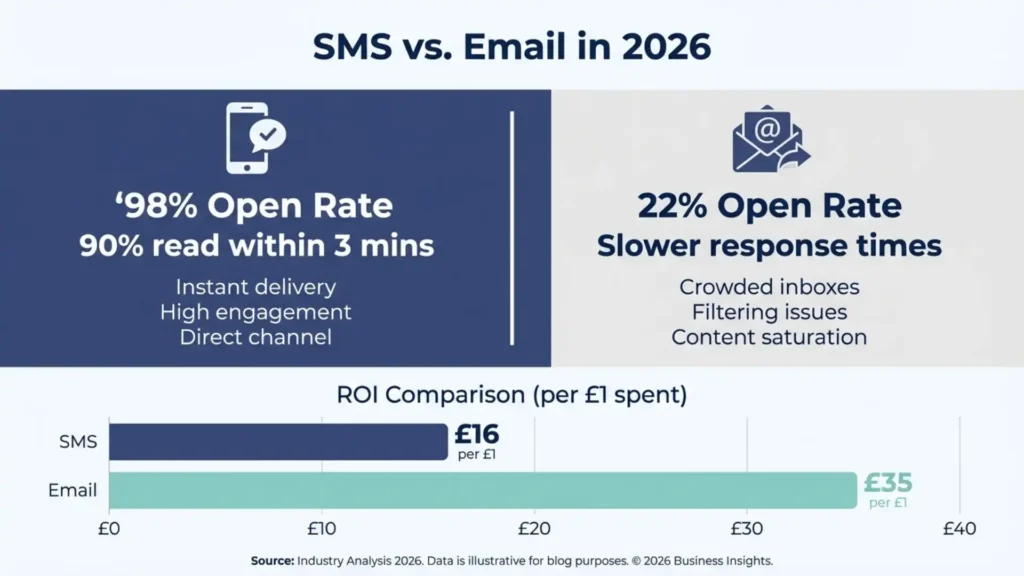
The most compelling argument for SMS marketing is not sentiment — it is open rate data. Text messages consistently achieve open rates of 96–98%, with the majority read within three minutes of delivery. Compare that to email, where an average open rate of 20–28% is considered strong, and the gap becomes clear.
This is not a new trend. SMS has maintained these figures precisely because texts land in a native inbox that every phone has by default, requiring no app download, no internet connection, and no algorithm deciding whether your message is shown. Unlike social media posts or email newsletters, there is no filter sitting between you and your customer.
Recent research in the UK found that 97% of adults over 54 prefer SMS as a communication channel over phone calls — not just younger demographics. This makes SMS marketing one of the few channels with genuine cross-generational reach for local businesses.
SMS marketing costs in the UK: how it compares
One of the biggest advantages of SMS marketing for UK local businesses is cost. Bulk SMS typically costs between 3p and 8p per message depending on volume and provider, making it one of the most affordable direct marketing channels available. For a local business with a customer list of 1,000, a full campaign might cost between £30 and £80 to execute.
UK data consistently shows returns of over £16 for every £1 spent on well-managed SMS campaigns. For comparison, paid social advertising typically returns somewhere between £3 and £8 per £1 spent, with significantly more complexity in targeting and creative production. Here is a direct comparison of marketing channels commonly used by UK local businesses:
| Feature | Spreadsheet | CRM |
|---|---|---|
Contact management |
Manual, error-prone |
Automatic, centralised |
Follow-up reminders |
None (set your own calendar alerts) |
Built-in automated reminders |
Team access |
Version conflicts common |
Real-time shared access |
Sales pipeline view |
Custom build required |
Visual pipeline included |
Email automation |
Not possible natively |
Triggered sequences built in |
Reporting |
Manual formulas |
Instant dashboards |
Scales with growth |
Gets harder as you grow |
Designed to scale |
Cost |
Often free |
Monthly subscription |
The cost-per-message figure for SMS needs to be viewed in context. Unlike email, where you can send thousands of messages for near-zero cost, SMS has a real per-unit cost. However, this cost is typically offset by significantly higher conversion rates — particularly for time-sensitive communications such as flash sales, appointment reminders, and last-minute offers.
For a local business spending, say, £50 per month on SMS campaigns, achieving even a modest 10% conversion rate from a 500-message send can generate meaningful revenue that paid channels would struggle to match at the same budget.
Where SMS marketing delivers the best results for local businesses
SMS is not equally effective across every use case. The highest-performing applications for local businesses share a common characteristic: they are tied to high-intent moments where the customer is already expecting or wanting contact.
Appointment reminders
This is arguably the single highest-value use case for SMS marketing in the UK. Research shows that appointment cancellations and no-shows drop by up to 32% when businesses use automated text reminders. For a salon, dental practice, physiotherapy clinic, or any service business where empty slots mean lost revenue, this reduction alone can justify the entire cost of an SMS marketing system many times over.
Businesses using automated SMS appointment reminders are consistently reporting measurable reductions in wasted slots and significant improvements in rebooking rates — often because the reminder itself prompts the customer to reschedule rather than simply not show up.
Flash sales and time-sensitive promotions
SMS is uniquely suited to urgency. A message about a 30% discount expiring in three hours gets opened and acted on far more effectively via text than via email. Real-world case studies from UK businesses show revenue per SMS of around £3.47 for flash sale campaigns, compared to roughly £0.82 for the equivalent email campaign — more than four times the return per message.
Loyalty and retention messages
Exclusive early-access offers, loyalty reward updates, and personalised “we miss you” messages perform well when sent by SMS. Because the customer has opted in and the message feels direct rather than broadcast, the engagement is significantly higher than with email for the same content.
Two-way customer communication
The shift in 2026 is away from one-directional broadcasting and towards conversational SMS. Customers expect to be able to reply to a text and receive a response. Local businesses that enable two-way SMS — for confirming bookings, answering simple queries, or collecting feedback — see stronger customer relationships and higher satisfaction scores than those still using “do not reply” numbers.
What SMS marketing looks like in 2026 vs a few years ago
The era of mass SMS blasts — where the same generic discount code went to every contact at 9am on a Tuesday — has largely passed, at least for businesses serious about results. 2026 SMS marketing is characterised by several distinct shifts:
- Behaviour-triggered messages replace scheduled broadcasts. Instead of sending a campaign to everyone on a fixed date, messages are triggered by specific customer actions — an appointment booked, a purchase made, a trial about to expire, a cart abandoned.
- Personalisation is expected, not optional. Generic texts perform significantly worse than personalised ones. Using the customer’s name and referencing a specific action or product they’ve engaged with consistently improves both open rates and conversions.
- AI-assisted timing and segmentation. Businesses using automation platforms can now send messages at the time each individual customer is most likely to engage, based on their historical behaviour, rather than a one-size-fits-all send time.
- SMS works alongside email, not instead of it. The most effective strategies use SMS for urgency and timing-sensitive communications while email handles relationship-building, newsletters, and longer-form content. Using both channels in a coordinated sequence outperforms either alone.
Not sure how much SMS marketing will cost your business?
In the UK, bulk SMS typically costs between 3p and 8p per message. While individual costs are low, the real value comes from high open rates and an average ROI of £16+ for every £1 spent.
UK rules and compliance: what local businesses need to know
SMS marketing in the UK is governed by GDPR and the Privacy and Electronic Communications Regulations (PECR). The core requirement is straightforward: you must have explicit, informed consent from the recipient before sending marketing texts. Bought lists, scraped contacts, and messages sent without a clear opt-in are not compliant and expose the business to significant fines.
Compliant SMS marketing in the UK requires:
- A clear opt-in mechanism, typically a sign-up form or a “text to join” keyword system, where the customer actively chooses to receive messages.
- A straightforward opt-out method included in every message (usually “Reply STOP to unsubscribe”).
- Messages sent only during reasonable hours — the generally accepted window is between 8am and 9pm, seven days a week.
- Honest identification of your business as the sender — do not mask who the message is from.
- A record of when and how consent was obtained, which you must be able to provide if asked.
The good news is that businesses with properly managed opt-in lists tend to have opt-out rates well below 3% per campaign, which suggests that compliant, value-driven SMS marketing is broadly welcomed by the customers who receive it.
How SMS fits into a wider marketing automation strategy
For local businesses in 2026, SMS marketing works best as part of a connected system rather than as a standalone channel. When SMS is integrated with a CRM, a booking calendar, and email marketing, the business gains a complete communication loop where every touchpoint is tracked, automated, and appropriate to the stage of the customer journey.
A practical example: a new enquiry arrives via a website form. An automated email follows immediately. If no response after 24 hours, an SMS follow-up is triggered. Once an appointment is booked, automated reminders go out by text. After the appointment, a review request is sent by SMS and email. A loyalty offer goes out 30 days later to encourage rebooking.
This kind of joined-up approach — where SMS plays a specific role in the overall customer journey rather than firing messages randomly — is what separates businesses that see strong ROI from those that describe SMS as “not working for them.” Understanding how business automation can save hours every week is often the starting point for seeing SMS as part of a system, rather than an isolated campaign.
Practical tips for running SMS marketing that works in 2026
- Keep messages short, specific, and with a single action. SMS is not the place for paragraphs. One clear message, one clear next step.
- Always send from a recognisable sender name, not an anonymous number. Customers are far more likely to engage when they know who is texting them.
- Avoid sending more than two to four messages per month unless the customer has specifically signed up for higher frequency. Oversending is the fastest route to opt-outs.
- Test send times. The same message sent at 10am on a Tuesday versus 6pm on a Thursday can produce noticeably different results. Track and adjust.
- Use SMS to complement email, not replace it. Both channels have different strengths. SMS wins on immediacy; email wins on detail and nurturing.
- Build your list organically through genuine opt-ins — in-store sign-ups, website forms, booking confirmation flows. A small, engaged list outperforms a large, uninterested one every time.
What the data says: SMS marketing in 2026
The UK’s communications regulator Ofcom confirms that UK adults now spend an average of more than four hours per day connected online, and mobile phones are the primary device for the majority of that time. For businesses wanting to reach customers at the moment of highest attention, mobile-first channels including SMS remain among the most reliable options available.
For those wanting to dig deeper into the research, the Ofcom Online Nation research hub publishes detailed annual data on UK digital communication habits — a useful reference for local businesses making decisions about where to invest their marketing budget.
Which types of local businesses benefit most from SMS marketing?
Virtually any business with a repeating customer relationship can benefit from SMS marketing, but certain sectors see the most consistent results:
- Salons, spas, and beauty businesses — appointment reminders, rebooking prompts, and loyalty offers.
- Dental and healthcare practices — recall messages, appointment confirmations, and health reminders.
- Restaurants and cafes — reservation confirmations, special event announcements, and limited-time offers.
- Gyms and fitness studios — class reminders, membership renewals, and session booking confirmations.
- Estate agents — property match alerts, viewing reminders, and follow-up messages after enquiries.
- Builders, tradespeople, and home services — job confirmation messages, quote follow-ups, and review requests after completion.
- Retail and e-commerce — restock alerts, flash sales, and personalised offers based on purchase history.
Businesses in industries such as beauty and wellness, dental practices, restaurants, and tradespeople that already use appointment booking and customer communication systems are typically best positioned to take immediate advantage of SMS automation, as the customer data and booking triggers are already in place.
So, does SMS marketing still work in 2026?
The short answer is yes — but with an important qualifier. SMS marketing works when it is done with purpose, personalisation, and proper consent. It does not work when it is used as a broadcast channel for generic promotions sent to poorly maintained lists.
For UK local businesses, the combination of near-universal open rates, low cost per message, and strong conversion performance on time-sensitive campaigns makes SMS one of the most cost-effective marketing tools available in 2026. The businesses that are seeing the best returns are the ones that have integrated text message marketing into a broader customer journey — connected to their CRM, booking system, and email automation — rather than treating it as a standalone broadcast tool.
The technology to do this is more accessible than ever. For small businesses that want to stop chasing clients manually and start engaging them automatically, SMS and WhatsApp marketing as part of an integrated automation platform offers a practical, measurable way to turn existing customer lists into consistent, repeatable revenue.
See how Fixxable helps you master SMS automation and ROI
From automated appointment reminders that reduce no-shows by up to 32% to behavior-triggered flash sales, Fixxable helps you integrate SMS into your wider marketing strategy. By connecting your CRM and booking systems, you can deliver personalized, high-intent messages that outperform traditional broadcast campaigns.