

What is a drip campaign and how do you set one up?
A drip campaign is a series of automated messages sent to a contact over time, triggered by a specific action or behaviour. Instead of sending one email to everyone at once, a drip campaign delivers the right message to the right person at the right moment — without you having to do anything manually after the initial setup.
If you have ever received a welcome email after signing up for a newsletter, a reminder about something left in your basket, or a helpful follow-up a few days after a purchase, you have been part of a drip campaign. For UK small businesses, setting one up is one of the most effective things you can do with email automation — and it is far simpler than it sounds.
What does a drip campaign actually do?
The name comes from the idea of dripping information to someone gradually, rather than overwhelming them with everything at once. Each message in the sequence builds on the last, moving the recipient closer to a goal — whether that is making a purchase, booking an appointment, completing a sign-up, or simply becoming more familiar with your business.
The key distinction from a standard email blast is timing and relevance. A drip campaign is not sent to your entire list on a set date. It is triggered individually for each contact based on what they did — or did not do. That makes every message feel more timely and personal, even though the whole thing runs automatically.
This is why drip campaigns are a cornerstone of email automation for small businesses. Once set up, they keep working in the background — nurturing leads, onboarding new customers, recovering abandoned enquiries — while you focus on running your business.
When should you use a drip campaign?
Not every communication needs to be a drip campaign, but there are several situations where they consistently outperform one-off emails. The most common use cases for UK small businesses include:
- Welcome sequences — sent to new leads or subscribers to introduce your business, set expectations, and build early trust.
- Lead nurturing — a gradual sequence that educates a prospect about your service and moves them closer to booking or buying.
- Client onboarding — for new customers who need to understand how to get started with your product or service.
- Re-engagement — for contacts who have gone quiet, reminding them of the value you offer and giving them a reason to come back.
- Post-purchase follow-up — thanking a customer, gathering feedback, or suggesting complementary services after a completed job.
- Appointment or booking reminders — timed automatically based on an upcoming date, reducing no-shows and admin time.
The common thread is a predictable customer journey with a clear next step. If there is a series of things you would ideally say to every new lead or customer — but you never quite get around to it — a drip campaign is the solution. Paired with a well-organised CRM system, the whole process becomes seamless.
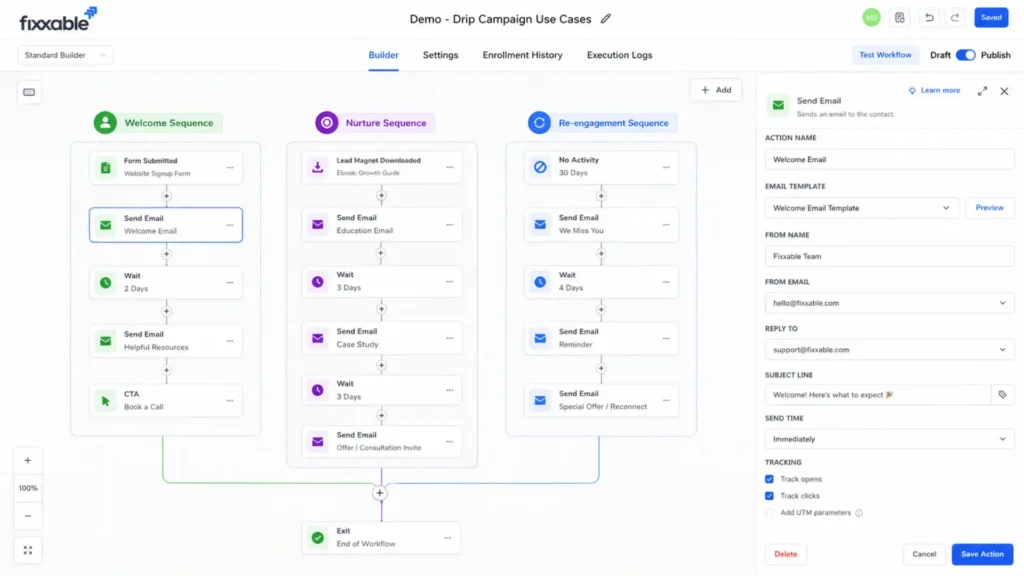
How to structure a drip campaign
Before you write a single email, you need to be clear on three things: who the sequence is for, what action triggers it, and what you want the recipient to do by the end.
Step 1: Define the trigger
Every drip campaign starts with a trigger — the specific event that kicks off the sequence for an individual contact. Common triggers include:
- Filling in a contact or enquiry form on your website
- Signing up for a newsletter or lead magnet
- Making a first purchase or booking
- Not responding to an initial message after a set number of days
- Being tagged or moved to a specific stage in your CRM pipeline
Choose a trigger that is meaningful and reliably measurable. Vague triggers — like “when someone seems interested” — cannot be automated and will cause the system to break down.
Step 2: Plan the sequence
Map out the full sequence before writing anything. Decide how many emails it will contain and what the purpose of each one is. A good rule of thumb for a lead nurturing email sequence is three to five messages, spaced two to four days apart. Going much longer than this without a strong reason risks becoming intrusive.
Each email should have a single clear purpose and a single call to action. Trying to do too much in one message dilutes its effectiveness. Think of each email as one step — not the whole staircase.
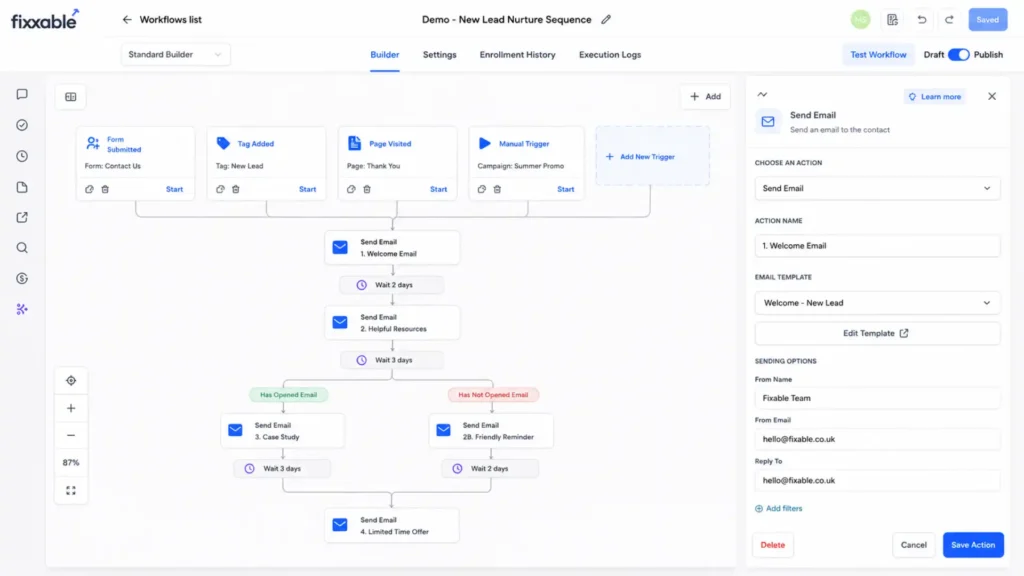
A simple structure for a new-lead nurturing sequence might look like this:
- Email 1 (Day 0): Welcome and introduce your business. Briefly explain what you do and what the lead can expect from you.
- Email 2 (Day 3): Share something useful — a tip, a short guide, or an insight relevant to their situation. No hard sell.
- Email 3 (Day 6): Address a common concern or objection your prospects typically have. Build trust and credibility.
- Email 4 (Day 10): Share a success story or testimonial. Show the result someone else achieved by working with you.
Email 5 (Day 14): A clear, confident call to action — invite them to book a call, request a quote, or take the next step.
Want to see how instant follow-up works in practice?
Fixxable is built to automate your website enquiry follow up from the moment a form is submitted. Book a free demo and we'll show you exactly how to set it up for your type of business — no tech skills required.
Step 3: Write the emails
Each email in a drip campaign should be short, focused, and written in a natural tone. Avoid overly formal language — this is a conversation, not a brochure. A few principles that make drip emails perform better:
- Keep the subject line specific and relevant to the email’s content. Vague subject lines like “Following up” are easy to ignore.
- Write as though you are emailing one person, not a list. Use their first name if you have it, and reference the action that triggered the sequence where it makes sense to do so.
- Each email should stand on its own. Not every recipient will have opened every previous message, so do not assume they have context they may not have.
One call to action per email. More than one gives the reader too many choices and typically reduces the rate at which any of them are taken.
Step 4: Set up the automation
Once your emails are written, you need to load them into your automation platform, set the triggers and delays between each message, and test the sequence before going live. Most email automation tools for small businesses allow you to preview how each email will look, test the trigger logic, and check personalisation fields before anything goes live.
Run a test on a real email address — your own or a team member’s — and step through the full sequence as a recipient would experience it. Check that the delays are correct, the links work, and the personalisation fills in properly before activating it for real contacts.
Step 5: Monitor and refine
Once your drip campaign is live, track the key metrics: open rate, click rate, and — most importantly — conversions. Which emails are being opened? Where do people drop off? Which call to action is being clicked?
Most campaigns can be improved with simple adjustments to subject lines, timing, or the content of individual emails. Small businesses benefit most from starting with a simple sequence and iterating, rather than trying to build the perfect campaign before launching. This links directly to the broader principle behind effective business automation — set it up, learn from it, and improve.
Drip campaigns beyond email: SMS and WhatsApp
Most people think of drip campaigns as email-only, but the same logic applies to SMS and WhatsApp sequences — and in some situations, those channels outperform email significantly.
SMS is particularly effective for time-sensitive messages: appointment reminders, follow-ups after a missed call, or a prompt to complete a partially submitted enquiry. Open rates for text messages are substantially higher than for email, making them well suited for messages where you need a fast response.
WhatsApp sequences work especially well for service businesses with an existing relationship with the client, where a more conversational tone feels natural. A short message checking in after a completed job, with a link to leave a review or rebook, can be built as a simple automated sequence. Fixxable’s WhatsApp and SMS marketing tools integrate directly with your contact list and CRM, so the same trigger logic that fires an email can also fire a text — without building two separate systems.
The best-performing drip campaigns for UK service businesses typically combine channels: an initial email, followed by an SMS if there is no response, with WhatsApp as a final touchpoint for high-value leads. This multi-channel approach increases overall response rates without requiring any more manual effort.
Common drip campaign mistakes to avoid
Even a well-intentioned drip campaign can underperform if a few common errors creep in. These are the issues that tend to cause the most problems:
- Starting too many sequences at once. It is tempting to build a campaign for every scenario — but five mediocre sequences will always underperform one well-built one. Start with your most important use case, get it working well, then expand.
- Ignoring unsubscribes and engagement signals. If a contact unsubscribes, they must be removed immediately. Beyond legal compliance, continuing to email disengaged contacts damages your sender reputation and reduces deliverability for everyone else on your list.
- Writing emails that are too long. Drip campaign emails are not blog posts. Most effective sequences use short, focused emails — often no more than 150 to 200 words — with a single clear next step.
- Setting delays that do not match the buying journey. A five-email sequence over five days might make sense for a quick purchase decision. It would be far too fast for a high-value B2B service where a prospect needs weeks to consider their options. Match the pace of your sequence to how your customers actually make decisions.
Forgetting to update content over time. A drip campaign set up twelve months ago may reference outdated pricing, offers, or services. Build a calendar reminder to review all active sequences quarterly.
Drip campaigns and GDPR: what UK businesses need to know
Any automated email or SMS sequence in the UK must comply with UK GDPR and the Privacy and Electronic Communications Regulations (PECR). The core principle is straightforward: you can only send marketing messages to people who have given clear consent to receive them, or with whom you have a legitimate business relationship.
For most drip campaigns, consent is captured at the point of sign-up — a contact form, a newsletter subscription, or a quote request. What matters is that the consent is recorded, the contact knows what they are signing up to receive, and they have a clear and easy way to opt out at any point in the sequence.
The ICO (Information Commissioner’s Office) provides detailed guidance for UK businesses on email and text marketing compliance. Before launching any drip campaign, it is worth reviewing their current position — the ICO’s direct marketing guidance is a practical starting point.
Keeping your contact data clean and your CRM system up to date is not just good practice — it is the foundation that makes compliant, effective drip campaigns possible.
Ready to set up your first drip campaign?
A well-built drip campaign can work for your business every day — nurturing leads, following up on enquiries, onboarding new clients, and bringing old ones back — without any additional manual effort from your team. Fixxable gives UK small businesses everything they need to build and run automated drip sequences across email, SMS, and WhatsApp from one connected platform. No complex setup. No separate tools. Just automation that works.