
Published on: April 13, 2026
The best chatbot questions to turn visitors into customers
The right chatbot questions to turn visitors into customers can be the difference between a bounce and a booking. Most businesses have a chatbot on their website — but very few use it strategically. The default “How can I help you today?” greeting is generic, forgettable, and lets potential customers slip away without taking any action.
The good news is that small, deliberate changes to how your chatbot opens a conversation can dramatically improve how many visitors become leads, and how many leads become paying customers. This guide covers the questions that actually work — organised by where visitors are in their buying journey.
Why most chatbot questions fail to convert
The problem with most chatbot conversations is not the technology — it is the questions. Generic prompts create generic engagement. When a visitor lands on your website, they have a purpose. They are comparing options, looking for a specific service, or ready to buy but have one lingering doubt. A vague opener like “Hi! Can I help?” does nothing to uncover that purpose.
Chatbots with purpose-driven opening questions see significantly higher engagement rates compared to those with generic greetings. The first message is the highest-leverage moment in the entire interaction. If it does not match the visitor’s intent, the conversation is already lost.
Effective chatbot conversion questions do three things well: they acknowledge context, reduce friction, and guide the visitor towards a clear next step. The goal is not to interrogate — it is to make the right question feel like a helpful conversation.
For businesses using a chatbot as part of their wider automation stack, the question design becomes even more important — because every answered question feeds into the wider customer journey.
Chatbot questions for first-time visitors
When someone lands on your site for the first time, they are often in discovery mode. They are curious, comparing options, or unsure whether you are the right fit. Your chatbot’s job at this stage is not to sell — it is to qualify and guide.
Questions that work well for new visitors include:
- “What brought you to us today — are you looking for [specific service A], [specific service B], or something else?”
- “Is this your first time looking into [service]? I can point you in the right direction.”
- “Are you researching options or ready to get started? Either way, I can help.”
- “What’s the main challenge you’re trying to solve right now?”
Notice that none of these are closed yes/no questions. They invite a short response that tells you something useful about what the visitor actually wants. That information is what powers the rest of the conversation — and, when connected to a CRM system, it ensures that every lead is captured with context that helps your team follow up effectively.
Chatbot questions for the consideration stage
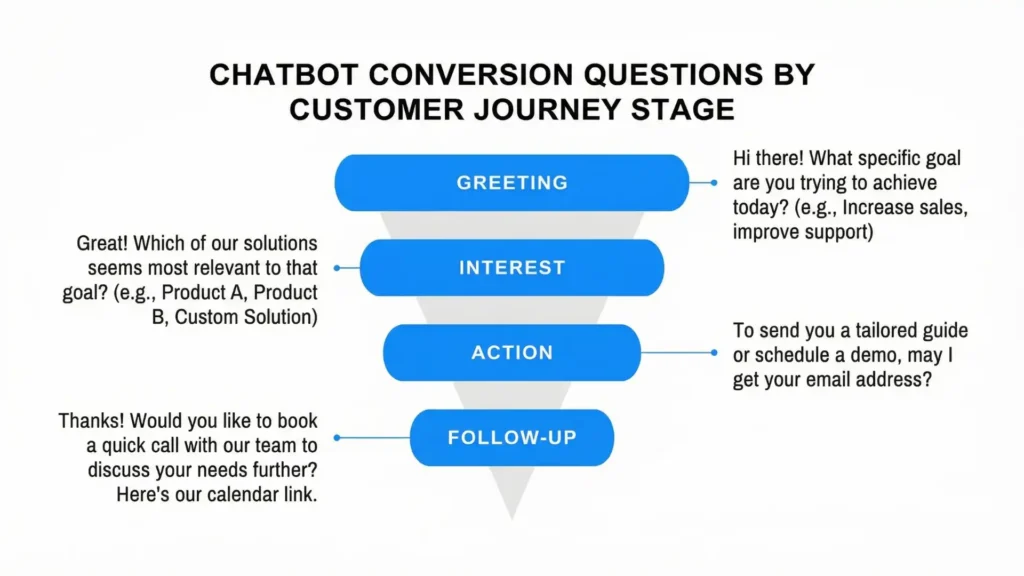
A visitor who has been on your site for a minute or two, or who has visited more than once, is further along in their thinking. They are not just curious — they are evaluating. At this stage, chatbot conversion questions need to address hesitation and provide relevant information.
These questions work well during consideration:
- “Have you seen our pricing? I can break down what’s included for your situation.”
- “Are you comparing a few options? I can tell you what makes us different.”
- “Do you have any specific questions before deciding? Most people ask about [X, Y, Z].”
- “Is there anything stopping you from moving forward today? I’m happy to help.”
The key here is to address objections before they become reasons to leave. A well-timed question about pricing, comparison, or concerns shows that your chatbot is helpful rather than pushy — and gives you the chance to provide a reassuring answer that moves the visitor closer to converting.
Not getting enough responses from your chatbot?
Generic questions like “How can I help?” rarely convert. The right prompts can qualify visitors, guide decisions, and turn conversations into bookings.
Chatbot questions that directly generate leads
For businesses focused on booking enquiries, generating quotes, or scheduling calls, the lead generation chatbot flow needs to transition smoothly from conversation to commitment. The questions here are about reducing friction at the point of action.
Questions that open the booking conversation
“Would you like to book a free consultation? I can check availability right now.” — This works because it removes the effort of navigating to a booking page and creates a sense of immediacy.
“What’s the best time to reach you — morning or afternoon?” — Giving two options is a classic sales technique that works just as well in chatbot conversations. The visitor is choosing when, not whether.
“Can I grab your email so I can send you a quick summary and availability?” — This phrasing frames the data collection as a service to the visitor, not a requirement.
Questions that qualify leads before they speak to your team
“How soon are you looking to get started?” — This instantly segments urgent leads from browsers and helps your team prioritise follow-up.
“Are you based in [location] or are we looking at a remote service?” — Simple, but it tells you a great deal about the lead’s relevance to your offering.
Businesses that pair a well-designed chatbot with a strong online appointment booking system see the best results here — the chatbot qualifies, the booking tool converts, and the process feels seamless to the visitor.
Industry-specific chatbot questions that convert
One of the most underused advantages of a lead generation chatbot is the ability to tailor questions to your specific industry and customer base. Generic questions get generic results. Specific questions create relevance — and relevance drives conversions.
Service businesses (trades, clinics, salons)
- “Are you a new customer or have you used us before?”
- “What service are you interested in — [Option A] or [Option B]?”
- “Is this something you need urgently, or are you planning ahead?”
Professional services (legal, financial, consultancy)
- “What type of matter are you looking for help with today?”
- “Have you dealt with this kind of issue before, or is this a first?”
- “Would a quick call to understand your situation be helpful?”
Retail and e-commerce
- “Are you shopping for yourself or looking for a gift?”
- “Do you already know what you’re looking for, or would you like some recommendations?”
- “Did you leave something in your basket? I can help you pick up where you left off.”
According to research from HubSpot, businesses that personalise chatbot interactions see significantly higher engagement rates compared to those using static scripts — making industry-specific question design one of the highest-return improvements any business can make. If you want to explore how this applies specifically to your sector, our overview of chatbot strategy by business type is worth a read.
What makes a chatbot question actually work?
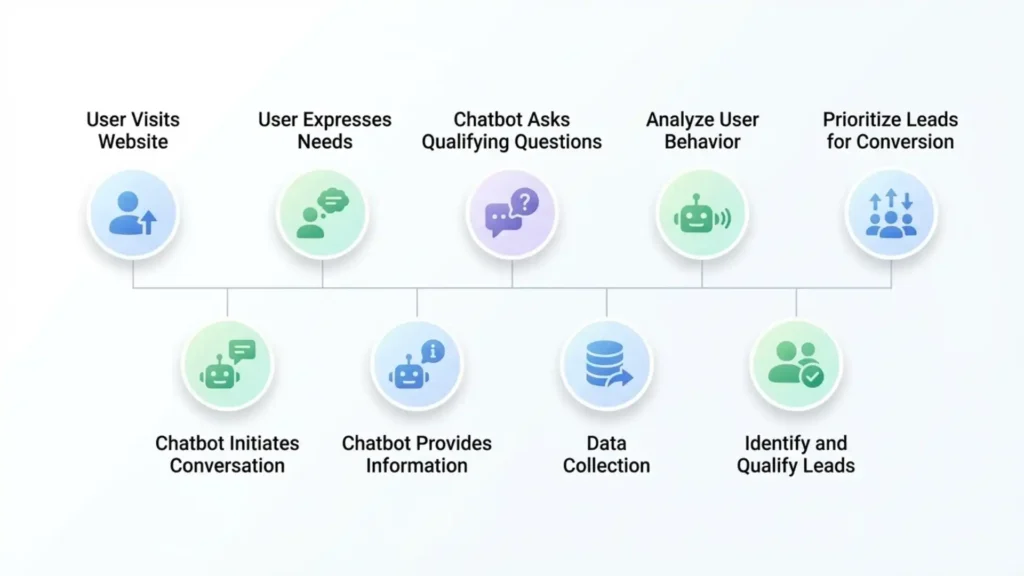
Beyond the specific questions themselves, there are principles that consistently separate high-converting chatbot conversations from the ones that get ignored. Understanding these principles helps you adapt any question to your own voice and audience.
- Context awareness. Questions triggered by page behaviour (a visitor on a pricing page, or someone who has visited three times) should be different from questions for a first-time visitor on the homepage.
- Short and direct. Long opening questions overwhelm people. The best openers are a single sentence that invites a short, easy response.
- Offer options rather than open-ended prompts. Quick-reply buttons with two or three specific options reduce effort and dramatically increase the number of people who respond.
- Brand voice alignment. A friendly, local trade business should not use the same formal tone as a law firm. The question needs to sound like your business, not a generic template.
- One question at a time. Asking multiple questions in a single message creates confusion. Each chatbot message should contain one clear question or prompt.
These principles apply whether you are setting up a basic website chatbot or building a more complex AI-powered automation flow that routes leads, triggers follow-ups, and integrates with your sales pipeline.
Start with the right question
The chatbot questions to turn visitors into customers do not need to be clever or complicated. They need to be relevant, timely, and easy to answer. The best ones feel like a natural conversation — not an interrogation or a corporate script.
Start by identifying the three most common reasons someone visits your website. Build one question for each. Test them. Look at how many people respond versus how many leave without engaging. Then refine.
If you would like to see how a well-configured chatbot can work alongside your existing tools — from your booking system and CRM through to WhatsApp and SMS — our live demo shows exactly how these conversations can be set up for a business like yours, without any technical knowledge required.
Turn more website visitors into enquiries with better chatbot questions
The way your chatbot opens a conversation has a direct impact on conversions. Intent-driven questions can guide visitors, uncover what they need, and move them towards booking or enquiring. Fixxable helps businesses design high-converting chatbot flows that capture leads, qualify enquiries, and connect seamlessly with your booking and follow-up systems.