

Why email marketing still works — and why it belongs in your sales arsenal
Every few years, someone declares email marketing dead. Social media, chatbots and now AI-driven channels have all been framed as replacements. Yet email remains a direct, measurable channel that businesses can use without relying on a social platform to decide whether a follower sees a post. That direct access is one of the main reasons why email marketing still works.
This isn’t nostalgia for an old technology. It’s because email still does something none of the newer channels fully replace: it reaches people directly, in a space they check daily, without depending on a platform’s algorithm to decide who sees it.
The case for email, in numbers
The Data & Marketing Association’s 2025 Email Benchmarking Report gives a more current picture than the old ROI headline that is still repeated online. For 2024, the DMA reported a 98% delivery rate, a 35.9% open rate and a 2.3% unique click rate across its benchmark data. Those are aggregate industry benchmarks, not a promise for any individual campaign, but they show that email continues to generate measurable engagement at scale.
Relevance still matters more than list size alone. Messages based on a customer’s interests, previous activity or stage in the relationship can perform better than a generic send to everyone. A smaller, engaged list can therefore be more valuable than a much larger list that receives the same untargeted message.
Why email keeps getting written off, and why that's a mistake
Three objections come up again and again.
- “Email feels old-fashioned.” Newer channels feel more exciting, but excitement isn’t the same as effectiveness. Many of the businesses dismissing email as outdated are the same ones struggling to get a consistent return from the channels they replaced it with.
- “Our emails end up in spam.” This is usually a sign of a poorly targeted list or weak subject lines and content, not evidence that email itself has stopped working. A well-maintained list, sent relevant messages, performs very differently.
- “We tried it and it felt like a lot of effort for not much return.” This is often true, but the problem is usually consistency rather than the channel. A newsletter sent occasionally, whenever someone remembers, will always underperform a structured, automated approach.
None of these problems mean email doesn’t work. They mean it was being run without the structure that makes it work.
What makes email different from social and paid channels
A social media audience depends on a platform’s algorithms, policies and continued popularity. An email list gives a business a more direct relationship with contacts because messages are sent to addresses the business has collected, subject to deliverability and privacy rules. That makes email less dependent on a single social platform’s distribution choices.
Email also often reaches people who have already shown interest by subscribing, enquiring or buying. That existing relationship can make email particularly useful for follow-up, education, re-engagement and repeat business, provided the business follows the applicable UK direct-marketing rules.
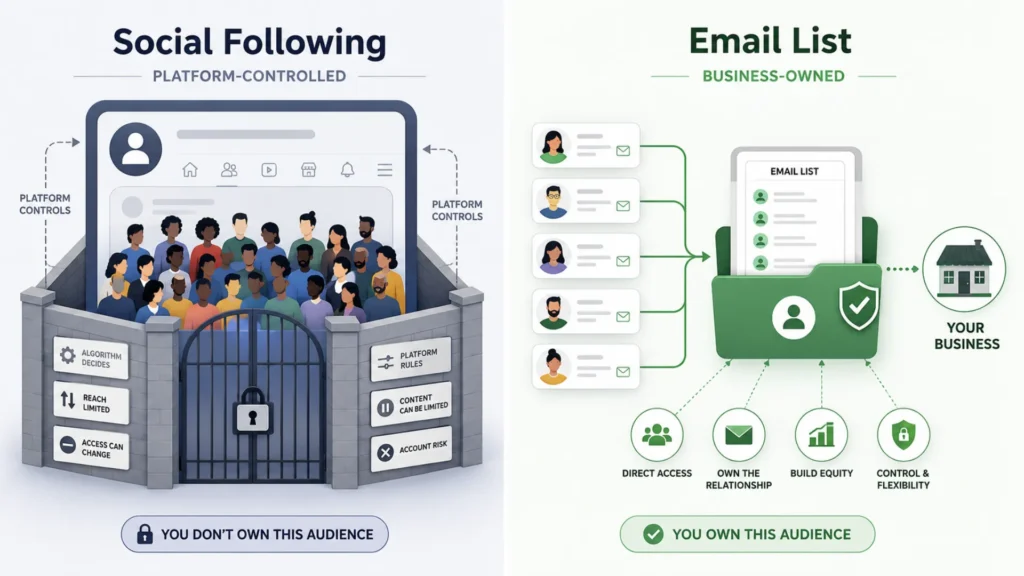
Why email marketing still works alongside newer channels
The strongest argument for email isn’t that it should replace every other channel. It’s that it does a specific job better than most alternatives: carrying longer, more considered messages that build a relationship over time, rather than competing for a few seconds of attention in a feed.
Fast, urgent updates, such as booking confirmations, reminders and time-sensitive offers, are often better suited to WhatsApp and SMS. Email works best alongside those channels, not instead of them, for the messages that benefit from more explanation: a new product launch, a seasonal offer, a case study, a re-engagement campaign for a customer who has gone quiet.
The real reason most small businesses let email marketing slip
It’s rarely a decision that email doesn’t work. It’s usually that keeping it running consistently takes time that a small team doesn’t reliably have. Building a segmented list, writing and sending a campaign, and then following up based on who opened or clicked, is a lot of manual admin to repeat every week or month, particularly when there’s a shop floor, a diary or a client to attend to at the same time.
That admin gap, not a lack of effectiveness, is what usually causes email marketing to quietly stop happening.
How automation removes the barrier that makes email lapse
Rather than relying on someone remembering to write and send a newsletter, email marketing automation lets a business set up messages that go out automatically based on what a customer actually does: a welcome sequence when someone first enquires, a follow-up when a quote hasn’t been actioned, a re-engagement message when a regular customer has gone quiet.
This works best when it draws on accurate, up-to-date customer information. A CRM system that keeps enquiries, purchase history and previous conversations in one place means an automated email can reflect what a customer has actually done, rather than being sent to everyone in the same generic way. The result is personalisation that happens automatically, rather than personalisation that depends on someone having the time to do it by hand.
Being able to see what’s actually working, through tracking and analytics, also makes it easier to keep improving a campaign instead of guessing whether it’s worth the effort.
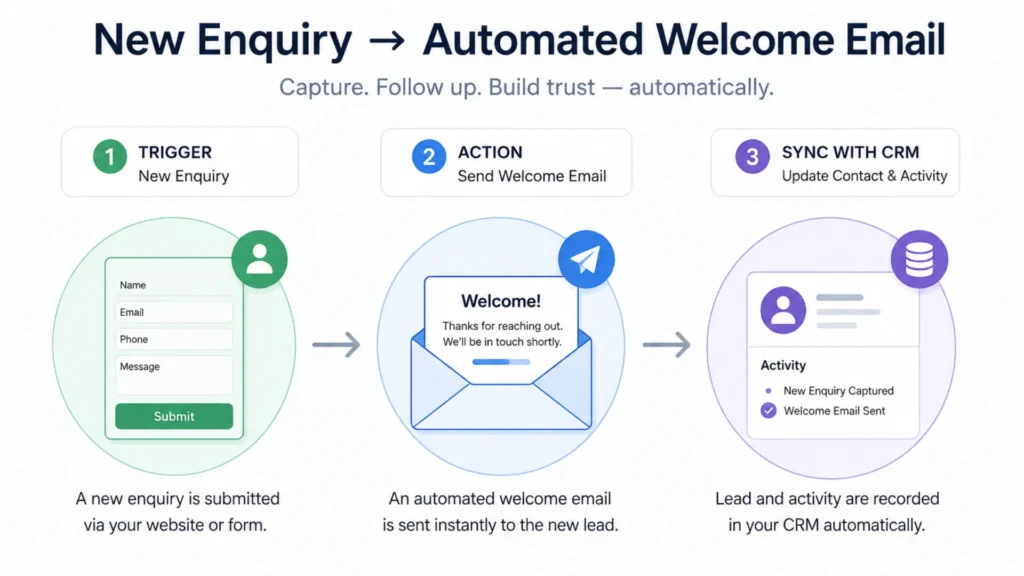
Wondering whether your business is getting enough from email marketing?
Fixxable brings email marketing automation, CRM data and reporting together in one system, so campaigns run consistently without adding to your team's admin.
Getting started without overhauling everything
Reviving email marketing doesn’t need to mean a complete rebuild. A useful starting point is usually smaller than businesses expect:
- Clean up the existing list, removing addresses that consistently bounce or never engage
- Set up one automated welcome message for new enquiries or sign-ups
- Add one re-engagement message for contacts who haven’t interacted in a while
- Review open and click data after a few sends, and adjust from there
Each of these can be automated once and then left to run, which is usually enough to turn email from an occasional, forgotten task back into a consistent part of how a business reaches customers.
Common questions about email marketing
Does email marketing still work in 2026?
Yes. The DMA’s latest public benchmark data continues to show high delivery and measurable engagement for email. Performance varies widely by list quality, sector, content and measurement method, so no single benchmark should be treated as a guaranteed result for an individual business.
Is email marketing better than social media for small businesses?
They serve different purposes rather than competing directly. Social media is useful for visibility and discovery, while email is stronger for building a direct, lasting relationship with people who have already shown interest in the business.
How often should a business send marketing emails?
Consistency matters more than frequency. A shorter, well-timed message sent regularly and automatically will usually perform better than an occasional long newsletter sent only when someone remembers.
Do I need a large list for email marketing to be worthwhile?
No. A smaller, genuinely engaged list that receives relevant, well-timed messages typically outperforms a much larger list sent the same generic content.
Ready to put email marketing back on autopilot?
Email marketing works best when it happens consistently, not only when someone remembers to send a campaign. Fixxable connects email marketing automation with your CRM data, so welcome emails, follow-ups and re-engagement campaigns can run automatically while staying relevant to each customer. Spend less time managing campaigns manually and more time acting on the responses they generate.