

How physiotherapy clinics can fill physiotherapy cancellation slots automatically
Physiotherapy cancellation slots are one of the most expensive problems in a busy clinic. A patient cancels 90 minutes before their appointment, the chair sits empty, the therapist is paid regardless, and that revenue is gone for good — unless you have a system in place to fill it instantly.
This guide covers how waitlist automation works, why it is the most effective tool for filling physiotherapy cancellation slots, and how to set up a workflow that captures interest, notifies patients the moment a slot opens, and confirms the physio appointment booking in a single tap.
Why physiotherapy cancellation slots cost more than you think
Cancellations feel like a minor annoyance until you add them up. A physiotherapy clinic running 30 sessions a week with a 15% cancellation rate loses around four or five appointments every week. At an average private session rate of £60 to £80, that is anywhere between £240 and £400 walking out the door — every single week.
Over a year, those physiotherapy cancellation slots represent £12,000 to £20,000 in lost revenue for a single practitioner. For multi-therapist clinics, multiply accordingly. And that figure does not include the wasted therapist time, the administrative cost of chasing patients, or the secondary cost of patients who cancel repeatedly and eventually drift away from the clinic entirely.
The problem is that most clinics have no reliable system for filling those slots once they open. A receptionist might ring down a paper list. A WhatsApp message might go to a handful of patients. But without automation, the window closes before the slot is filled — and the revenue is lost permanently.
What waitlist automation actually does
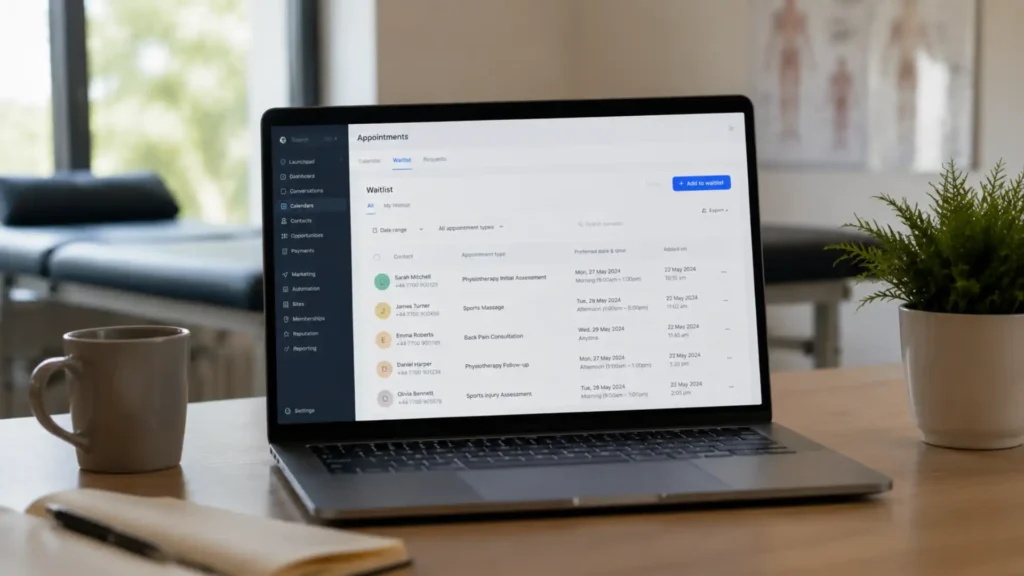
Waitlist automation is the process of systematically capturing patient interest in specific appointment slots, then using software to notify the right patients the moment a cancellation occurs — all without any manual input from your team.
Here is how a well-configured waitlist automation workflow operates:
- A patient tries to book an appointment and finds their preferred time is unavailable. Rather than leaving the booking journey, they join the waitlist for that slot with a single tap.
- The system stores their preferences: appointment type, preferred therapist, and time window.
- When a cancellation comes in — whether by phone, SMS reply, or online — the automation triggers instantly and sends a notification to the most relevant patients on the waitlist simultaneously.
- The first patient to respond via the confirmation link gets the slot. The booking is confirmed automatically, the diary updates in real time, and the remaining waitlisted patients are notified that the slot has gone.
- A new reminder sequence is triggered for the newly booked patient, just as it would be for any standard physio appointment booking.
The entire process — from cancellation to confirmed replacement booking — can happen in under two minutes, with no staff involvement required. Compare that with the manual approach, where a receptionist might spend 20 to 30 minutes working through a list and still fail to fill the slot.
How to capture waitlist interest from patients
The most effective waitlists are built continuously, not just when a cancellation occurs. There are several natural points in the physio appointment booking journey where patients can express interest in earlier or alternative slots.
When a patient tries to book online and their preferred time is unavailable, your booking system should immediately offer a waitlist option rather than a dead end. This turns a failed booking attempt into a captured lead for future slots. Patients who are offered this option at the point of frustration are highly motivated — they actively want an appointment and simply could not get one when they tried.
For patients already in the diary who are booked several weeks out, a brief message asking whether they would like to be notified of earlier cancellations is a simple, low-friction way to build your waitlist further. Many patients say yes, because they would genuinely prefer an earlier slot.
Reception staff can also add patients to the waitlist manually when someone calls to enquire about availability outside normal booking channels. A good waitlist automation platform will let your team log preferences — appointment type, therapist, and preferred time window — on a patient’s behalf, so no interest is lost.
Instant notifications: the critical difference between filling and losing a slot
Speed is everything when it comes to filling physiotherapy cancellation slots. Research across healthcare scheduling consistently shows that the probability of filling a cancelled slot drops sharply after the first two to four hours following the cancellation. After that window, most patients have made other arrangements or simply forgotten the original prompt.

Automated instant notifications solve this by removing the human delay entirely. The moment a cancellation is registered, the system fires a message to multiple waitlisted patients at the same time. It does not wait for a receptionist to notice the gap, check the list, and start making calls.
The most effective notification channels for physio appointment booking confirmations are SMS and WhatsApp — both achieve significantly higher open rates than email and are read within minutes in the vast majority of cases. A well-worded message might read something like: ‘A session has opened this Thursday at 2pm with [Therapist]. Reply YES to confirm or tap the link to book.’
Fixxable’s WhatsApp and SMS marketing tools make it straightforward to configure these real-time outbound notifications as part of a broader physio appointment booking workflow, without requiring any technical setup from your team.
Is your clinic losing revenue to unfilled physiotherapy cancellation slots?
your current process relies on a receptionist working through a paper list or a manual WhatsApp message, you are almost certainly leaving money on the table every week. Fixxable’s appointment booking system includes built-in waitlist management and automated slot notifications designed specifically for UK clinics. Get in touch with our team to see how it works for physiotherapy practices.
Is your clinic losing revenue to unfilled physiotherapy cancellation slots?
If your current process relies on a receptionist working through a paper list or a manual WhatsApp message, you are almost certainly leaving money on the table every week. Fixxable's appointment booking system includes built-in waitlist management and automated slot notifications designed specifically for UK clinics. Get in touch with our team to see how it works for physiotherapy practices.
One-click confirmation: removing the friction from rebooking
The most common reason waitlisted patients fail to claim a cancelled slot is friction. A patient receives a notification that a session has opened, but to confirm they need to call the clinic, wait on hold, and speak to a receptionist. By the time they get through, someone else has taken it. Or they simply give up.
One-click confirmation eliminates this entirely. The notification sent to waitlisted patients includes a direct booking link that confirms the appointment instantly when tapped. No phone call. No form to fill in. No waiting. The patient taps the link, the slot is booked, and a confirmation message is sent back automatically.
This single change — moving from a call-back model to a tap-to-confirm model — can dramatically increase the proportion of physiotherapy cancellation slots that are successfully filled. Patients who would otherwise not bother to pick up the phone are happy to confirm with a single tap from their sofa. The convenience removes the last barrier between an interested patient and a confirmed booking.
Once confirmed, the new physio appointment booking is treated exactly like any other — a reminder sequence is triggered, the therapist’s calendar is updated, and the patient record is logged. There is no additional manual work required from your team at any stage.
Building a waitlist that stays accurate and up to date
A waitlist is only as useful as the data it contains. A list full of patients who have already booked elsewhere, recovered on their own, or simply lost interest will generate failed outreach that wastes the critical slot-filling window.
Keeping your waitlist accurate requires a few simple practices. First, set an expiry on waitlist entries — a patient who joined the list six weeks ago for a slot that same week is unlikely to still be relevant. Regular automated prompts asking waitlisted patients to confirm they are still interested help remove stale entries without any manual review.
Second, segment the waitlist by appointment type and therapist preference. A patient waiting for a sports injury assessment should not be notified about a women’s health physiotherapy slot. Targeted notifications mean higher response rates and a better experience for patients.
Third, keep the waitlist connected to your main booking system in real time. When a waitlisted patient books through another channel, they should be automatically removed from the relevant waitlist entries to prevent notifications about slots they can no longer use.
Fixxable’s physiotherapy clinic automation tools are built to keep all of this connected — your waitlist, your diary, your patient records, and your communications platform all update together so nothing falls out of sync.
Handling habitual cancellers: a smarter approach
Not all physiotherapy cancellation slots come from patients who genuinely could not make it. Some come from patients who cancel repeatedly, often with little notice, making it difficult to fill the slot in time. Handling these patients differently — rather than applying the same reminder sequence to everyone — is a more effective strategy.
For patients with a pattern of late cancellations, a few targeted adjustments can make a significant difference. A clear cancellation policy, communicated at booking and in every reminder, sets expectations early. For NHS-referred patients, this might include reminding them of the impact repeated cancellations have on their treatment progression. For private patients, a deposit requirement or pre-payment for future bookings is a reasonable and common approach.
Automation can help here too. A platform that tracks cancellation history per patient can automatically flag high-risk bookings and trigger a different reminder sequence — perhaps including an earlier confirmation request, a phone call reminder, or a personalised message from the treating therapist. This is far more manageable when handled by software than when left to a busy reception team.
Integrating waitlist automation into your existing clinic workflow
The biggest barrier to adopting waitlist automation for most physiotherapy clinics is the perception that it requires a complex technical setup. In practice, for the right platform, the integration is straightforward.
The key requirements are:
- A booking system that supports waitlist entries — patients need to be able to join the waitlist at the point of a failed booking, either online or via reception.
- Real-time cancellation detection — the system needs to know the moment a slot opens, whether the cancellation comes in by phone, SMS, email, or online form.
- Automated outbound messaging — instant SMS or WhatsApp notifications to matched waitlist patients, with a direct confirmation link.
- Calendar integration — confirmed replacement bookings must update the live diary immediately to prevent double-bookings.
Fixxable brings all of these elements together in one connected UK platform. Its voice agents and missed call text-back tools also ensure that patients who try to cancel by phone outside of opening hours are captured and offered a reschedule option automatically — so you never lose a slot to an out-of-hours voicemail.
What good looks like: a complete cancellation-to-filled-slot workflow
Putting everything together, here is what a fully automated physiotherapy cancellation workflow looks like from start to finish:
- 9:14am — A patient cancels their 11:30am appointment by replying CANCEL to their reminder message.
- 9:14am — The system detects the cancellation, marks the slot as open in the live diary, and triggers the waitlist notification workflow.
- 9:14am — Three waitlisted patients who match the appointment type and therapist preference receive an instant SMS: ‘A slot has opened today at 11:30am with [Therapist Name]. Tap to confirm your booking: [link]’
- 9:16am — The first patient taps the link. The booking is confirmed instantly, the diary is updated, and a confirmation message is sent.
- 9:16am — The other two waitlisted patients receive an automated follow-up: ‘This slot has now been filled. We will be in touch when another becomes available.’
- 9:16am — A new reminder sequence is triggered for the newly booked patient: a confirmation now, a WhatsApp reminder the day before, and an SMS on the morning of the session.
From cancellation to confirmed replacement physio appointment booking: two minutes. Zero manual input from your team. Zero lost revenue.
The Chartered Society of Physiotherapy provides guidance on the use of digital tools and technology in modern physiotherapy practice, including scheduling and patient communication workflows.
Ready to fill every physiotherapy cancellation slot automatically?
Waitlist automation is one of the most immediately impactful changes a physiotherapy clinic can make to its scheduling operations. It protects revenue, reduces admin, and delivers a better experience for patients who are keen to be seen sooner. The technology is straightforward to set up, and the results show quickly.
Fixxable is built for UK service clinics including physiotherapy practices — bringing appointment booking, waitlist management, automated reminders, and patient communication together in one connected platform. We set everything up for you and tailor it to your specific clinic workflow.