
Published on: March 23, 2026
How automation can help in the hotel and leisure industry
Hotel and leisure industry automation is reshaping the way hospitality businesses operate, from the moment a guest first makes an enquiry to the follow-up message they receive after checkout. The pressure on hotels, restaurants, spas, and leisure venues has never been greater — margins are tight, guests expect instant responses, and staff time is always limited.
Business automation offers a practical solution to many of these pressures. Rather than hiring more people to handle routine tasks, hospitality businesses are using automation to take those tasks off their team’s plate entirely — freeing staff to focus on the guest experience while systems handle everything running in the background. This article breaks down exactly what hotel and leisure industry automation looks like in practice, which areas benefit most, and how to start building it into your operations.
If you are new to the concept, it is worth understanding why your business needs automation in the first place — the case for it applies across sectors, but it is particularly compelling in hospitality where repetitive tasks are constant and the cost of slow responses is high.
The specific challenges that make hotel and leisure industry automation so valuable
Hospitality automation is not a new idea, but it has become far more accessible and practical for businesses of all sizes. The challenges driving demand are familiar to anyone who has run a hotel, a restaurant, or a leisure venue.
Guests increasingly expect to receive instant confirmation when they make a booking, get a fast response when they send an enquiry, and hear from the venue again after their visit. Meanwhile, staff are juggling front-of-house duties, phone calls, admin, and team communication — often all at the same time.
The result is that important follow-ups get missed, enquiries go cold, reviews do not get requested, and repeat bookings are left on the table. Hotel and leisure industry automation addresses each of these gaps by creating reliable, consistent processes that run whether your team is busy or not.
Staffing has also become a persistent challenge in hospitality. Venues that have historically relied on large teams are finding that automation allows them to maintain service quality with leaner staffing — not by replacing the human element, but by removing the repetitive administrative work that consumes so much of a team’s day.
Where business automation makes the biggest difference in hospitality
Not every task in a hotel or leisure business can or should be automated. The areas that benefit most are those involving repetitive communication, data management, and processes that follow a predictable pattern. Here is where automation tends to deliver the clearest results.
Booking confirmations and enquiry responses
One of the most immediate wins in hotel and leisure industry automation is the handling of new enquiries and booking confirmations. When someone fills in a contact form, sends a WhatsApp message, or calls and leaves a voicemail outside of business hours, an automated system can respond within seconds — acknowledging their enquiry, sending confirmation details, or requesting the information needed to move things forward.
This matters because speed is directly linked to conversion. An enquiry that receives an instant response is far more likely to convert to a booking than one that waits hours for a reply. Automation removes the delay entirely, regardless of when the enquiry comes in.
Appointment and reservation management
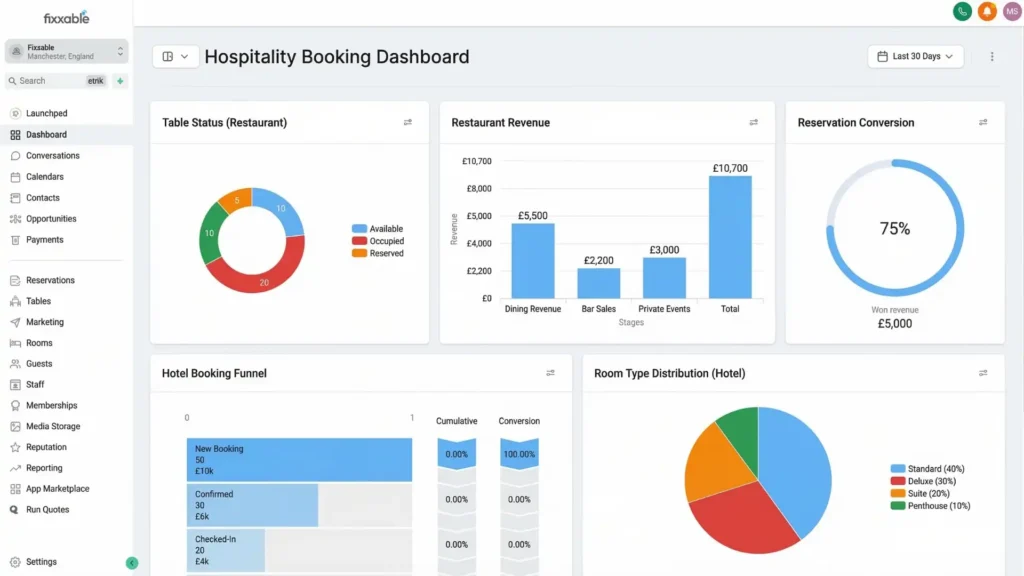
Automated appointment booking systems allow guests to book their own slots directly — whether for a table, a treatment, a room, or a facility — without requiring any manual input from staff. The system checks availability in real time, sends confirmation automatically, and follows up with reminders as the date approaches.
This dramatically reduces no-shows, removes the back-and-forth of manual reservation management, and keeps your booking calendar accurate without anyone having to update it manually. For hotels managing multiple room types and restaurants managing covers, this kind of business automation can save significant time every single week.
Guest communication and follow-ups
Hotel and leisure industry automation makes it possible to maintain consistent communication with guests throughout their journey — before, during, and after their visit — without placing that burden on individual members of staff.
Pre-arrival messages can confirm bookings, share useful information about the venue, and offer upgrades or add-ons. Post-stay follow-ups can thank guests for visiting, request a review, and invite them to rebook. These touchpoints build loyalty and generate repeat business, but they rarely happen consistently without automation, because team members are too busy with in-the-moment demands to remember them reliably.
Review management and online reputation
Online reviews are among the most powerful drivers of new bookings in hospitality. A steady flow of recent, positive reviews on Google, TripAdvisor, and booking platforms significantly improves visibility and conversion — but generating them requires asking, and most venues do not ask consistently enough.
Hospitality automation can trigger a review request automatically after each stay or visit, sent at the optimal time and through the channel most likely to get a response. Over time, this builds a consistent stream of reviews that reflects the quality of the experience you are providing — without anyone on your team having to remember to send the request.
Payment and invoicing
Automated payment processes reduce the administrative burden of chasing deposits, processing balances, and sending invoices. Business automation tools can send payment links at the point of booking, chase outstanding balances automatically, and generate receipts without manual input. For venues handling high volumes of bookings, this alone can save many hours each week.
Hotel and leisure industry automation and the sales pipeline
Many hospitality businesses do not think of their sales process as a pipeline — but it is. A guest searches online, finds your venue, makes an enquiry, books, visits, and (ideally) comes back. At each stage of that journey, there is an opportunity to move the relationship forward, and there is also a risk of losing them to a competitor who responds faster or follows up more effectively.
Automating the sales pipeline in a hospitality context means building workflows that guide potential guests from first contact to confirmed booking, and from confirmed booking to loyal repeat visitor. Our guide on what sales pipeline automation actually means for a business covers the mechanics in detail — but in a hotel or leisure context, the principle is straightforward: every step that currently relies on someone remembering to do something can be made automatic.
Hospitality automation at the pipeline level means that a guest who enquires about a private dining event, for example, receives a prompt response, gets follow-up information if they do not reply, and is nudged at the right moment to make a decision — all without a member of your sales team having to track each conversation manually.
Missing guest enquiries or follow-ups?
Automate replies, booking confirmations, and reminders so every enquiry gets a fast response.
Saving hours every week through smarter operations
One of the most tangible benefits of business automation in hospitality is the time it gives back to your team. Admin tasks that currently take hours each week — responding to routine enquiries, sending confirmation emails, chasing reviews, processing payments, updating booking records — can all be handled automatically. Our article on how business automation saves hours every week explores this in practical terms, with examples of exactly where the time goes and how automation recovers it.
In hotel and leisure industry automation, those recovered hours translate directly into better guest experiences. When your front-of-house team is not distracted by chasing emails, updating spreadsheets, or manually confirming bookings, they can focus on the interactions that matter — the ones that make guests feel genuinely looked after and keep them coming back.
For smaller venues, the impact can be even more pronounced. A boutique hotel or independent restaurant with a small team often cannot afford to dedicate staff time to admin. Automation makes it possible to run a professional, responsive operation without needing a large back-office function to support it.
Practical examples of hotel and leisure industry automation in action
To make this concrete, here are some real-world automation scenarios that hospitality businesses use regularly.
- Missed call recovery: A guest calls outside of opening hours. An automated text message is sent immediately, acknowledging the call and inviting them to respond or book online. The venue never loses the enquiry to a missed call again.
- Automated booking reminders: A guest books a table for a Friday evening. Two days before, they receive a reminder with the booking details and a prompt to confirm or amend. No-shows drop, and the team does not need to make manual reminder calls.
- Post-stay review requests: A guest checks out of a hotel room on a Sunday morning. On Monday, they receive a personalised follow-up message thanking them for their stay and including a direct link to leave a Google review. The venue’s review count grows steadily without any manual effort.
- Upselling and upgrade communications: A guest with a room booked for two nights receives an automated message three days before arrival offering an upgrade at a discounted rate. The message is triggered automatically based on availability — no staff involvement required until the guest responds.
- Loyalty and re-engagement: A guest who visited six months ago and has not returned receives a personalised message with a seasonal offer. Automated communications keep past guests engaged and bring them back without requiring staff to manually identify and contact them.
Getting started with hotel and leisure industry automation
The most common mistake when approaching hotel and leisure industry automation for the first time is trying to automate everything at once. A more practical approach is to start with the areas that are causing the most pain — missed enquiries, inconsistent follow-ups, or time-consuming admin — and build from there.
A good starting point is to map out the journey your guests take from first contact to post-visit, and identify every point where a communication currently relies on someone remembering to do it. Those are your automation opportunities.
Key questions to ask when planning your automation strategy:
- How quickly do new enquiries currently receive a response, and what happens to out-of-hours contacts?
- Are booking confirmations and reminders sent consistently, or does this depend on who is on shift?
- Do guests receive a follow-up after their visit, and are reviews being requested regularly?
- How is your team currently tracking guest communications, and are any conversations falling through the gaps?
- Are deposits, balances, and invoices being chased manually, and how much time does that take each week?
The full range of automation features available through Fixxable covers all of these areas — from CRM and booking management through to email automation, WhatsApp messaging, review management, and payment processing. Each feature is built to work together, so you are not managing a collection of separate tools but a single platform that handles the full guest journey.
See how hotel and leisure industry automation works for your business
Automation is not a future investment for hospitality businesses — it is already a practical reality for venues of all sizes that want to reduce admin, improve response times, and grow their repeat bookings without increasing headcount. The businesses starting to build these systems now are gaining a genuine operational advantage over those that are not.
If you would like to see how Fixxable’s platform works in a hospitality context, you can book a free demo and explore the features with one of our team. Alternatively, if you have specific questions about how automation would work for your venue, get in touch and we can talk it through — no obligation, just a straight conversation about what is possible.
Still managing guest enquiries and bookings manually?
Hospitality businesses lose bookings when enquiries are missed or replies are delayed. Fixxable automates enquiry responses, booking confirmations, reminders, and guest follow-ups — so every enquiry is captured and every guest receives a fast response, even outside opening hours.