

Published on: March 10, 2026
How estate agents can benefit from automation
Estate agent automation is no longer something reserved for large corporate agencies. Whether you run a single branch or a growing multi-office firm, automation gives you the ability to do more with the team you already have — without burning them out on admin.
From handling enquiries at midnight to chasing compliance documents without lifting a finger, the right automation tools can transform how your agency operates day to day. In this guide, we look at the real ways estate agents can benefit from automation, and why more agencies across the UK are making it a core part of how they work.
Why estate agent automation matters now
The property market moves fast. Buyers and sellers expect immediate responses, accurate information, and a smooth process from first enquiry through to completion. At the same time, agents are dealing with more admin, tighter compliance requirements, and the constant pressure to generate new business.
Research consistently shows that the majority of small businesses that have adopted automation report being able to compete more effectively with larger rivals. For estate agents, that means a local independent firm can deliver the kind of responsiveness and consistency that was once only achievable by a big brand with a large support team.
The key shift is this: automation does not replace the human side of agency work. It removes the repetitive, time-consuming tasks that get in the way of it. When agents spend less time chasing paperwork and sending follow-up emails manually, they spend more time with clients — and that is where deals are actually won.
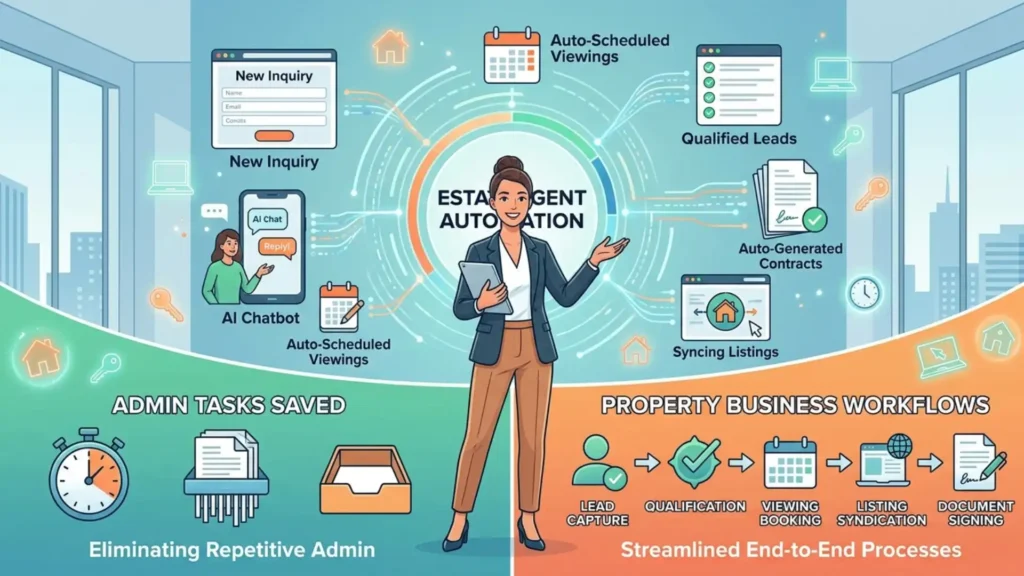
1. Never miss a lead with 24/7 automated enquiry handling
One of the most powerful benefits of estate agent automation is the ability to respond to enquiries around the clock — even when your office is closed. A buyer browsing property portals at 9pm does not want to wait until the next morning for a response. If a competitor replies first, you may have already lost them.
Automated chatbots, AI receptionists, and instant follow-up sequences mean every enquiry gets acknowledged immediately, key qualification questions get asked, and your team wakes up to a prioritised list of warm leads ready to action — rather than an inbox full of cold messages to triage.
Tools like AI chat and voice agents can handle initial enquiries, pre-qualify buyers and vendors, and book viewings directly into your calendar — all without any manual input from your team.
2. Automate estate agency tasks to save hours every week
When you look at how an estate agent automation actually spends their day, a significant portion of it is taken up by tasks that follow a predictable pattern: sending a viewing confirmation, chasing a mortgage broker for an update, reminding a vendor to complete their property questionnaire, or following up after a valuation appointment.
These tasks are important — but they do not need a human to do them every single time. When you automate estate agency tasks like these, you effectively give every member of your team extra hours each week to focus on revenue-generating activity instead.
Common tasks that are straightforward to automate include:
- Viewing confirmation emails and SMS reminders
- Post-viewing feedback requests sent automatically to applicants
- Valuation follow-up sequences over email and SMS
- Vendor progress update emails at key milestones
- Review requests sent after completion
- Re-engagement campaigns for cold leads in your database
How appointment booking automation works in practice
Automated appointment booking takes the back-and-forth out of scheduling viewings entirely. Instead of phone calls to check availability and confirm times, applicants can book directly into your calendar based on real-time availability — with confirmations and reminders sent automatically. No-shows drop significantly when reminders are automated, and your team spends zero time managing the diary manually.
Send matching properties to buyers and renters automatically
Another practical use of estate agent automation is automatically sending new property listings to buyers or renters whose saved criteria already match. Instead of staff manually checking the database and emailing suitable contacts one by one, the system can identify matches and send property details as soon as the listing goes live.
This saves time, but it also helps agents respond faster when interest is highest. Buyers and tenants are more likely to engage when relevant listings reach them quickly, and automation reduces the risk of suitable properties being missed or delayed.
It also improves the applicant experience. Rather than sending broad updates, agents can make sure buyers or renters receive listings that genuinely fit their requirements, including location, budget, property type and number of bedrooms. For busy branches, that means less repetitive admin and a more efficient route from instruction to enquiry.
The property matching demo shows how suitable new listings can be sent automatically to matching buyers or renters, helping agents reduce manual work while keeping enquiries moving.
Still managing enquiries and follow-ups manually?
3. Improve lead management and stop opportunities slipping through
Managing leads manually in a busy agency is a recipe for missed opportunities. Enquiries come in from portals, your website, social media, and referrals — and without a structured system, some will inevitably fall through the cracks.
Property business workflow automation means every lead is captured in one place, assigned to the right agent, and automatically entered into a follow-up sequence based on where they are in the buying or selling journey. Leads that go quiet are not forgotten — they receive re-engagement messages at set intervals, keeping your agency front of mind when they are ready to move forward.
Agencies that serve the residential property market specifically, like those using tools built for estate agents and property professionals, benefit from workflows tailored to the specific stages of the sales and lettings process — from initial enquiry right through to completion.
Lead scoring and prioritisation
Not all leads are equal, and automation can help your team focus their time where it matters most. Automated lead scoring tracks behaviour — how many times someone has visited your website, whether they have opened your emails, how recently they enquired — and surfaces the warmest prospects for your team to prioritise. This is a level of insight that is simply not possible to replicate manually at scale.
4. Strengthen client communication without more effort
Strong communication is at the heart of a good agency experience. Buyers and sellers want to feel informed and in control throughout what is often a stressful process. The challenge for agents is that keeping everyone updated manually is time-consuming, inconsistent, and easy to deprioritise when the day gets busy.
Automated communication workflows solve this problem by ensuring clients receive timely, relevant updates at every stage — without your team having to remember to send them. Whether it is a progress update email when a sale moves to solicitors, an SMS when a viewing is confirmed, or a follow-up message after an offer is submitted, automation ensures the touchpoints happen consistently every time.
This kind of consistent, proactive communication builds trust and significantly reduces the volume of inbound ‘where are we up to?’ calls your team has to handle. Clients feel looked after; your team gets their time back.
5. Simplify compliance and reduce risk
Compliance has become one of the most time-consuming parts of running an estate agency. Anti-money laundering checks, Know Your Customer requirements, identity verification, and Material Information obligations all demand careful documentation and consistent processes.
Automation takes much of the manual effort out of compliance by triggering the right checks at the right point in the process, chasing outstanding documents automatically, and maintaining a clear audit trail for every transaction. Nothing gets missed because the workflow will not progress until the required step is completed.
For lettings agencies in particular, where compliance obligations across tenancies are ongoing and high-volume, property business workflow automation can be the difference between staying on top of legal requirements and facing costly mistakes.
6. Boost your marketing without increasing your workload
Generating new business — new valuations, new landlords, new applicants — requires consistent marketing activity. But when your team is stretched, marketing is often the first thing to fall behind.
Automation changes this by running your marketing activity in the background, regardless of how busy the office is. Drip email campaigns keep past clients engaged. WhatsApp and SMS broadcasts can notify your database of new listings the moment they go live. Social proof is built automatically as review requests go out after every completed transaction and positive responses are channelled to your public profiles.
The range of automation tools available to agencies today covers everything from email marketing and SMS campaigns to reputation management and pipeline tracking — all connected in a single platform rather than spread across multiple disconnected systems.
7. Use data to make better business decisions
One of the less-discussed benefits of automating your agency workflows is the quality of data it generates. When your processes are automated, every action is logged, timestamped, and measurable. You can see exactly which lead sources are converting, how quickly your team is responding to enquiries, where in the sales process deals are stalling, and which marketing campaigns are driving actual viewings.
This level of visibility is transformative for agency owners who have previously been making decisions based on instinct rather than evidence. Automated reporting and dashboards mean you can identify problems early and act on them — before they become revenue issues.
Exploring how automation tools work across different industries shows how consistent the underlying logic is: capture more, respond faster, follow up better, and measure everything. For estate agents, this translates directly into more instructions and more completions.
What estate agents can realistically automate today
The question is not whether estate agent automation is worth investing in — it clearly is. The more practical question is where to start. The good news is that you do not need to automate everything at once. A phased approach, starting with the areas that cost your team the most time, delivers results quickly and builds confidence in the technology.
A sensible starting point for most agencies covers the following areas:
- Enquiry response and lead capture — ensure every inbound contact is acknowledged instantly and entered into your CRM automatically
- Viewing confirmations and reminders — remove the manual back-and-forth from appointment booking and reduce no-shows
- Post-viewing follow-up — automate feedback requests and keep applicants engaged without chasing them manually
- Vendor communication — keep sellers updated at every stage without adding to your team’s daily to-do list
- Compliance checks — trigger the right AML and KYC processes automatically at the point in the workflow where they are needed
From there, agencies typically expand into automated marketing campaigns, lead re-engagement, review collection, and more sophisticated reporting — building a system that runs consistently in the background while their team focuses on the high-value work that requires human expertise.
How to get started with estate agent automation
The most important thing is to begin. Many agency owners put off implementing automation because it feels like a large project — but the reality is that modern platforms are designed to be set up quickly and start delivering value within days, not months.
The key is to choose a platform that is genuinely built around your workflows rather than a generic tool that has been loosely adapted for property. Look for something that handles lead capture, CRM, communication, booking, and compliance in one place — rather than stitching together five separate tools that do not talk to each other.
If you want to see how estate agent automation could work for your specific agency, booking a demo is the fastest way to understand what is possible and how quickly you can get results.
The agencies that move on this now will not just be more efficient — they will be providing a materially better client experience than competitors who are still doing everything manually. In a market where trust and responsiveness win instructions, that is a significant and compounding advantage.
If you have questions before taking the next step, the Fixxable team is ready to help you work out the right approach for your agency’s size, structure, and goals.
Estate agent automation that keeps enquiries moving
Stop chasing leads manually. Fixxable helps estate agent automate enquiry responses, viewing confirmations, follow-ups, and client updates — so every lead is captured and every opportunity is followed up automatically. Your team spends less time on admin and more time winning instructions and closing deals.