
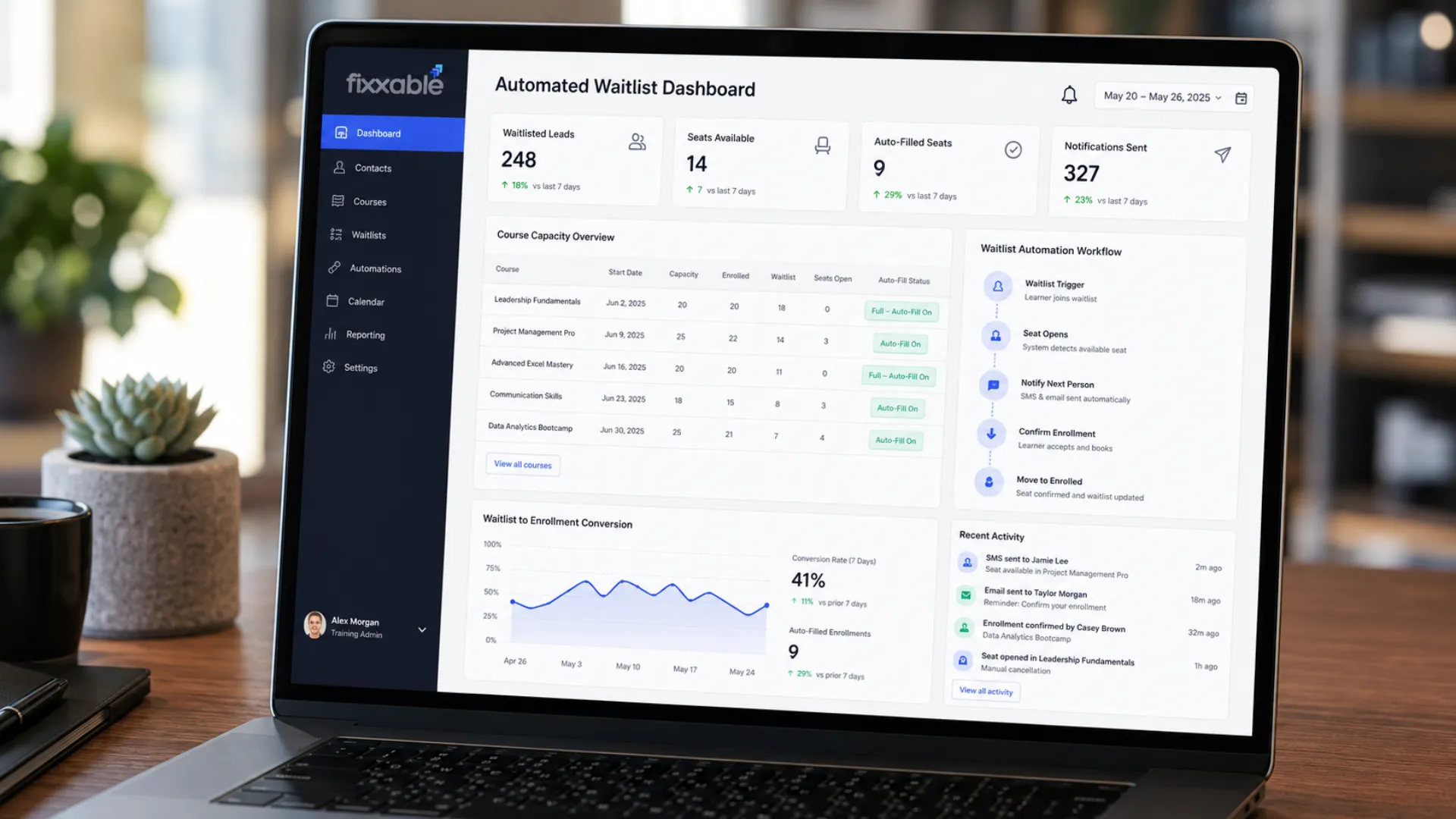
How an automated waitlist for training courses fills spaces faster
Empty seats on a training course rarely happen because nobody was interested. They happen because interest wasn’t captured, followed up, or reminded in time. An automated waitlist for training courses fixes this gap by capturing spare demand and turning it into confirmed bookings the moment a space opens or a deadline approaches.
Most training providers already have some way to capture interest — a contact form, an email list, a spreadsheet of “maybes”. The problem isn’t a lack of interest. It’s that manual follow-up can’t move fast enough when a course is filling, or when someone drops out three days before the start date.
This guide covers how to build a training course waitlist that runs itself, and how urgency email sequences turn that waitlist into filled seats before the deadline passes. It’s written for UK training centres, academies, and course providers who run cohorts, workshops, or apprenticeship intakes and want fewer empty seats without adding more admin.
Why training providers lose spaces to slow manual follow-up
Course capacity is one of the easiest wins in training, and one of the easiest to lose. A prospective learner enquires, gets added to a spreadsheet or an inbox folder, and then waits. If nobody follows up within a day or two, they book with a competitor, or simply forget the course existed. Multiply that across a dozen courses a term, and a training provider can be sitting on hundreds of pounds in unclaimed enrolment revenue without realising it.
The same problem shows up in reverse. A course fills, and instead of catching every enquiry that comes in afterwards, staff either turn people away or scribble names on a waiting list that nobody chases. When a space opens up two days before the start date, whoever manages that list has to remember it exists, find the right person, and reach them in time, all while running the rest of the course.
For busy training teams, this manual chasing eats hours every week. Worse, it costs bookings. People respond fastest to offers when there’s a genuine sense of limited availability, which is exactly the moment manual processes are too slow to capture. Structured course waitlist management closes that gap before it costs you a booking.
What is an automated waitlist for training courses?
Automated waitlist for training courses is a system that captures anyone who enquires about a full or nearly-full course, then automatically manages what happens next: confirmation messages, position updates, and instant notification the moment a space becomes available.
Instead of a spreadsheet that only one member of staff can read, everyone who joins the waitlist gets an immediate response. When someone cancels or a new cohort is scheduled, the system already knows who to contact first, in what order, and how urgently. For learners, that speed feels like good service. For the training provider, it’s the difference between a full cohort and a course that runs under capacity.
How urgency email sequences turn interest into bookings
Capturing names on a waitlist only solves half the problem. The other half is getting waitlisted learners to actually book once a space opens.
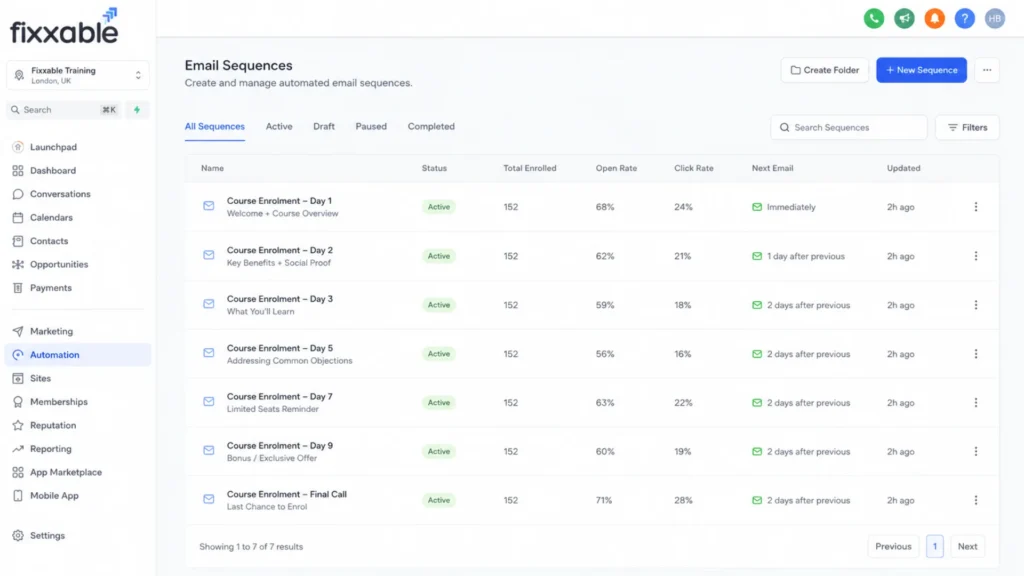
This is where urgency email sequences do the work. Rather than a single notification, a short sequence goes out over a few hours or days: an initial “a space is available” message, a reminder if there’s no response, and a final “last chance” message before the space is offered to the next person in line. Each message reinforces that the opportunity is genuinely time-limited, because it is.
Setting up an automated waitlist for training courses in four steps
Building an automated waitlist for training courses doesn’t need custom software or a big IT project. Most UK training providers can have one running within a day using their existing enquiry forms and a connected CRM system. That’s the foundation of solid course waitlist management, and it’s the same infrastructure the urgency sequences rely on later.
- Capture every enquiry automatically. Connect your website enquiry form, phone calls, and walk-in sign-ups so no interested learner ends up on a sticky note.
- Tag learners by course and cohort. When a space opens on a specific date, the system already knows exactly who to contact first.
- Set the notification order. Choose first-come first-served, or prioritise by deposit paid, course type, or enquiry date.
- Connect confirmation and payment. A learner can claim their space and pay within the same message thread, without waiting for a callback.
Not sure how many enquiries your team is quietly losing?
Most training providers underestimate how many enquiries never get a timely follow-up, until they actually look. If you'd like a second pair of eyes on your enrolment process, get in touch with the Fixxable team and we'll walk through where automation could recover lost bookings.
Scarcity-driven urgency email sequences that fill the last few spaces
The last few spaces on any course are the hardest to sell and the easiest to lose to indecision. This is where scarcity-driven messaging earns its keep, not as a pushy sales tactic, but as an honest signal that time and space really are running out.
Well-built urgency email sequences for a nearly-full course typically include:
- A “filling fast” notice sent once the course passes 70–80% capacity, so undecided learners see the countdown for themselves.
- A final-spaces alert with an exact number remaining, sent to the waitlist and any recent enquirers together.
- A booking deadline message tied to a real cut-off, such as materials ordering or room capacity, rather than an arbitrary date.
- A last-chance reminder sent a few hours before the deadline closes, for anyone who opened the earlier message but didn’t act.
These messages work because the urgency is real. A course genuinely does have a fixed number of seats, and a genuine deadline gives learners a reason to decide today instead of putting it off until next week.
Course waitlist management best practices for busy training teams
Good course waitlist management isn’t about chasing harder. It’s about making sure nothing depends on someone remembering to check a list. A few habits make the biggest difference:
- Keep the waitlist visible to the whole team, not just whoever took the original enquiry, so cover and holidays don’t create gaps.
- Review waitlist numbers before every cohort starts, so under-subscribed courses get an early promotional push instead of a late one.
- Respond to a cancellation within minutes, not days. The learner at the top of the list is often comparing you with other providers in real time.
- Keep a record of who was offered a space and when, so nobody is skipped or contacted twice.
- Set a soft cut-off for waitlist offers, such as 24 hours to respond, so an unclaimed space is automatically passed to the next learner instead of sitting open.
None of this needs to be manual. Once course waitlist management runs on autopilot, staff spend their time teaching and planning, not refreshing an inbox.

What changes when waitlists and urgency sequences run automatically
When an automated waitlist for training courses and its follow-up messages run without manual input, the biggest change isn’t speed. It’s consistency. Every enquiry gets a response. Every cancellation gets filled. Every deadline gets a reminder, whether a staff member remembers to send it or not. Reporting improves too, since every waitlist join, message sent, and booking confirmed is logged automatically instead of living in someone’s memory.
This consistency also shows up in communication. Training providers using email marketing automation and WhatsApp and SMS marketing alongside a training course waitlist can reach learners on whichever channel they actually check, rather than relying on a single inbox that’s opened once a day.
The psychology behind this is well documented. Research on the psychology of persuasion shows that people respond to genuine limited availability out of a concern about missing an opportunity, which is precisely why a well-timed urgency sequence, built on real scarcity rather than invented pressure, converts so reliably.
For UK training centres, academies, and course providers already managing enrolments, reminders, and attendance through a connected training centre management system, adding an automated waitlist and urgency email sequences is a natural next step rather than a separate project.
Ready to fill your next course faster?
Every unfilled seat on a training course is a missed enquiry that was never followed up in time. Fixxable connects your enquiry forms, waitlist, and urgency email sequences into one system, so spaces get filled automatically instead of manually. Book a short call and we'll show you exactly how it would work for your courses.