

How builders and tradespeople win more jobs with faster quote follow-up
Quote follow-up is one of the biggest reasons one tradesperson wins more jobs than another, even when their prices are almost identical. You can prepare a clear, competitive quote, but if you never check in afterwards, the homeowner may choose the builder who made the decision easier.
This guide explains how builders and tradespeople can use speed-to-quote automation, structured follow-up sequences and seasonal nurture campaigns to convert more enquiries into confirmed work.
Why quote follow-up decides who gets the job
Homeowners rarely choose the cheapest builder. They often choose the tradesperson who communicates clearly, responds promptly and feels easiest to deal with.
Speed plays an important role in that first impression. When a homeowner contacts several builders, the first businesses to respond professionally are more likely to remain under consideration. Every day an enquiry sits unanswered increases the chance that another tradesperson will secure the work.
Quote follow-up matters just as much after the quote has been sent. A homeowner who has gone quiet may still be interested. They could be comparing options, discussing the project with a partner, reviewing their budget or waiting for another quote.
Sometimes, the original message may simply have been missed or sent to a spam folder. Without a follow-up, silence can easily be mistaken for rejection.
Fast quoting gets your business into consideration, but consistent quote follow-up keeps it there. An automated process ensures that every homeowner receives a timely response without adding more manual admin to your working day.
Get your first quote out fast
Speed-to-quote automation begins before you start preparing the price. The moment an enquiry arrives through your website, phone, email or social media, it should enter a system that your team can act on quickly.
Enquiries that remain in personal inboxes can easily be missed overnight or forgotten during a busy working day. A centralised system makes it easier to record customer details, assign responsibility and move the enquiry towards a quote.
Builders who send quotes within a day are already ahead of many competitors. Fixxable’s builders automation can help you create and send quotes quickly, then convert accepted quotes into invoices without repeating the same administrative work.
Automation does not remove the personal element. It gives you more time to speak with the customer, assess the job properly and deliver the work.
Keep the quote itself quick to read
A fast quote still needs to be clear. Homeowners should be able to understand what is included, how much it will cost and what happens next without reading several pages of complicated wording.
A useful quote should clearly show:
- The customer’s name and project address
- The agreed scope of work
- Labour and material costs
- Any exclusions or optional items
- The estimated start date and duration
- The total price and payment terms
A quote that is quick to send but confusing to read will still slow down the homeowner’s decision.
Clear formatting also reduces unnecessary questions. When the customer can easily see what is included, they are more likely to feel confident about accepting the work.
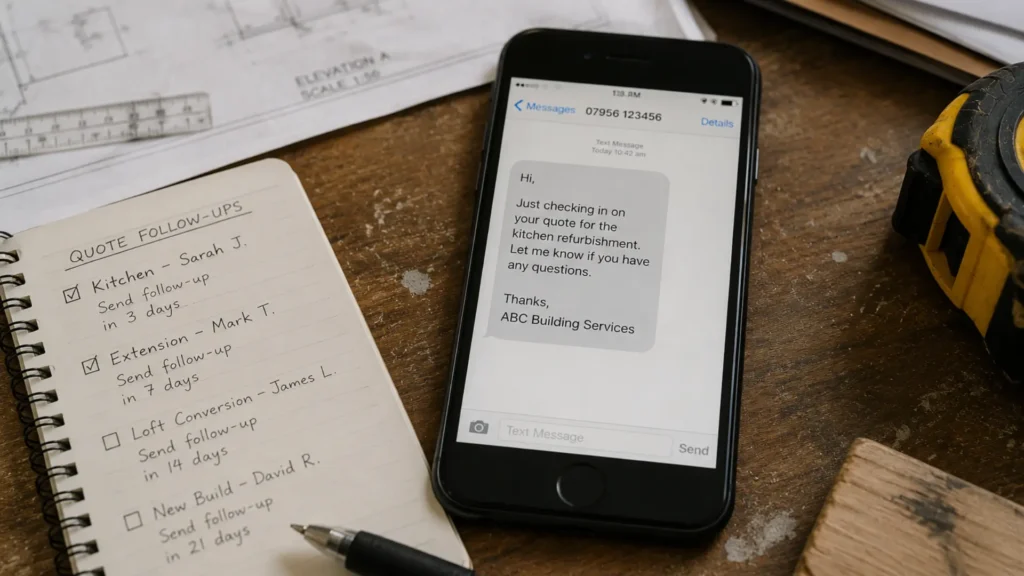
Build a follow-up sequence for unresponsive leads
Many tradespeople send a quote once and never follow up again. That is exactly why a simple quote follow-up process can make your business stand out.
A useful sequence normally includes an initial check-in within 24 to 48 hours, a second message around one week later and a final low-pressure follow-up after another week.
The purpose is not to repeatedly chase the homeowner. It is to make sure the quote arrived, answer any questions and provide a clear next step.
Different types of jobs may require different communication channels. A phone call may suit a large extension or renovation with several decisions involved. A short text message may be more appropriate for a smaller repair or when an earlier call went unanswered.
Automated WhatsApp and SMS follow-ups allow these messages to go out on schedule, even during your busiest working weeks.
Set the automation to stop as soon as the homeowner replies, accepts or declines the quote. This prevents unnecessary messages and keeps the follow-up process professional and personal.
What to say in a follow-up message
The tone of the message matters as much as the timing. A quote follow-up should feel helpful rather than pushy.
A short, effective follow-up normally includes:
- A friendly opener that mentions the specific job
- Confirmation that the quote was received
- An offer to answer questions or explain the scope
- A reminder of your current availability
- A simple next step for accepting or discussing the quote
Avoid sending a long message that repeats the entire quotation. A homeowner is more likely to respond to three clear, friendly lines.
For example:
Hi Sarah, I wanted to check that you received the quote for the bathroom renovation. Please let me know if you have any questions about the work or pricing. We currently have availability from the second week of September if you would like me to reserve a date.
This message is specific, useful and easy to answer. It also gives the homeowner a practical reason to make a decision.
Tradespeople who treat follow-up messages as part of the quoting process, rather than optional admin, are more likely to win jobs consistently throughout the year.
Ready to stop chasing quotes manually?
Relying on memory makes it difficult to know which quotes require attention each week. A structured automation system can send timely reminders, record customer replies and stop follow-ups when a decision has been made.Fixxable can help you build a follow-up sequence around your trade, enquiry volume and usual sales process.
Track every quote so nothing slips through
Once you are sending more than a few quotes each month, memory is no longer a reliable tracking system.
A quote that was due for a follow-up on Tuesday can easily be forgotten after several site visits, urgent phone calls and changes to the work schedule.
A CRM system built to organise customer follow-ups can show:
- Which enquiries are waiting for an initial response
- Which customers require a site visit
- Which quotes are still being prepared
- Which quotes are due for a follow-up
- Which customers have accepted or declined
- Which leads have stopped responding
This gives you a clear view of your sales pipeline without depending on one person to remember every conversation.
It also prevents duplicate or poorly timed messages. Anyone authorised to manage the enquiry can see what was sent, when it was sent and whether the homeowner replied.
Qualify enquiries before preparing a quote
Following up becomes more effective when you qualify the enquiry before spending time preparing a detailed quote.
A short conversation can help you understand the customer’s budget, preferred timing and expectations. You may also need to confirm whether drawings, planning permission or structural information already exist.
Useful questions include:
- What work would you like completed?
- When would you like the project to begin?
- Have you set an approximate budget?
- Do you already have plans or measurements?
- Are you collecting quotes from other contractors?
- Who will make the final decision?
These questions do not need to feel like a formal interview. Their purpose is to make sure the job is suitable for your business and that the homeowner is ready to proceed.
Better-qualified enquiries lead to more accurate quotes. They also make each quote follow-up more relevant because you understand what matters most to the customer.

Turn one-off jobs into repeat business with seasonal nurture campaigns
Winning the job is only part of the value created by good quote follow-up. The habits that help you secure the work—checking in, communicating clearly and sending useful messages at the right time—can also bring customers back.
Seasonal nurture campaigns allow you to stay in contact with previous clients without constantly sending sales messages.
A heating engineer could remind customers to arrange a service before winter. A roofer could offer inspections following a season of severe weather. A landscaper could contact previous clients before spring maintenance begins.
These messages work because they relate to something the customer is already likely to be considering.
The timing and subject should reflect the service previously provided. A generic message sent to every contact is less effective than a relevant reminder based on the customer’s property or previous project.
Automated invoicing and payment workflows also contribute to the customer experience.. Turning an accepted quote into an invoice quickly reduces delays and avoids repeated data entry.
A client who experiences a smooth and straightforward payment process is more likely to remember the business positively, recommend it to others and return for future work.
A quote follow-up sequence you can copy
Tradespeople who consistently win more jobs normally follow the same basic process instead of deciding what to send each time.
Here is a simple sequence that works across many trades.
Day 1 to 2: Confirm the quote arrived
Send a short message confirming that the homeowner received the quote. Offer to answer questions about the price, scope or proposed schedule.
Day 7: Mention current availability
Follow up again if there has been no response. Mention any relevant availability without creating false pressure.
For example:
Hi James, I’m following up on the roofing quote sent last week. Please let me know if you would like to discuss any part of it. We currently have an opening later this month if that timing would suit you.
Day 14: Send a final low-pressure message
Leave the door open without continuing to chase the lead.
For example:
Hi James, I wanted to send one final follow-up regarding the roofing quote. I’ll leave it with you for now, but please feel free to get in touch if you would like to proceed or discuss the work later.
After the job: Thank the customer
Once the work is complete, send a thank-you message. This is also an appropriate time to request an honest review.
During the relevant season: Check in again
Send a useful reminder related to the completed work. Keep it relevant and avoid contacting the customer too frequently.
Not every lead will require every step. However, having the sequence prepared means your team does not need to decide from the beginning what to send next.
Why a fast, clear quote protects you too
Quote follow-up is not just about winning the work; it also matters once you have it. Once a homeowner accepts a quote, it typically becomes the price you are both bound to, which is why the legal weight a quote carries once it is accepted is worth understanding before you send one out.
Being clear and prompt during the quoting stage protects both sides. It gives the homeowner confidence that your business is organised and provides a documented record of what was agreed.
The quote should define the work, materials, price and payment conditions as clearly as possible. When the customer later asks for additional work, you can explain that it falls outside the accepted scope and provide a separate variation or updated price.
This reduces misunderstandings and makes it easier to manage changes fairly.
Ready to follow up on every quote automatically?
Builders and tradespeople do not always need to be the cheapest option to win more jobs. Success often comes from responding quickly, following up consistently and making it easy for the homeowner to proceed.
Fixxable brings speed-to-quote automation, structured follow-up sequences, CRM tracking, invoicing and seasonal nurture campaigns into one organised process, so valuable enquiries are less likely to be forgotten.