
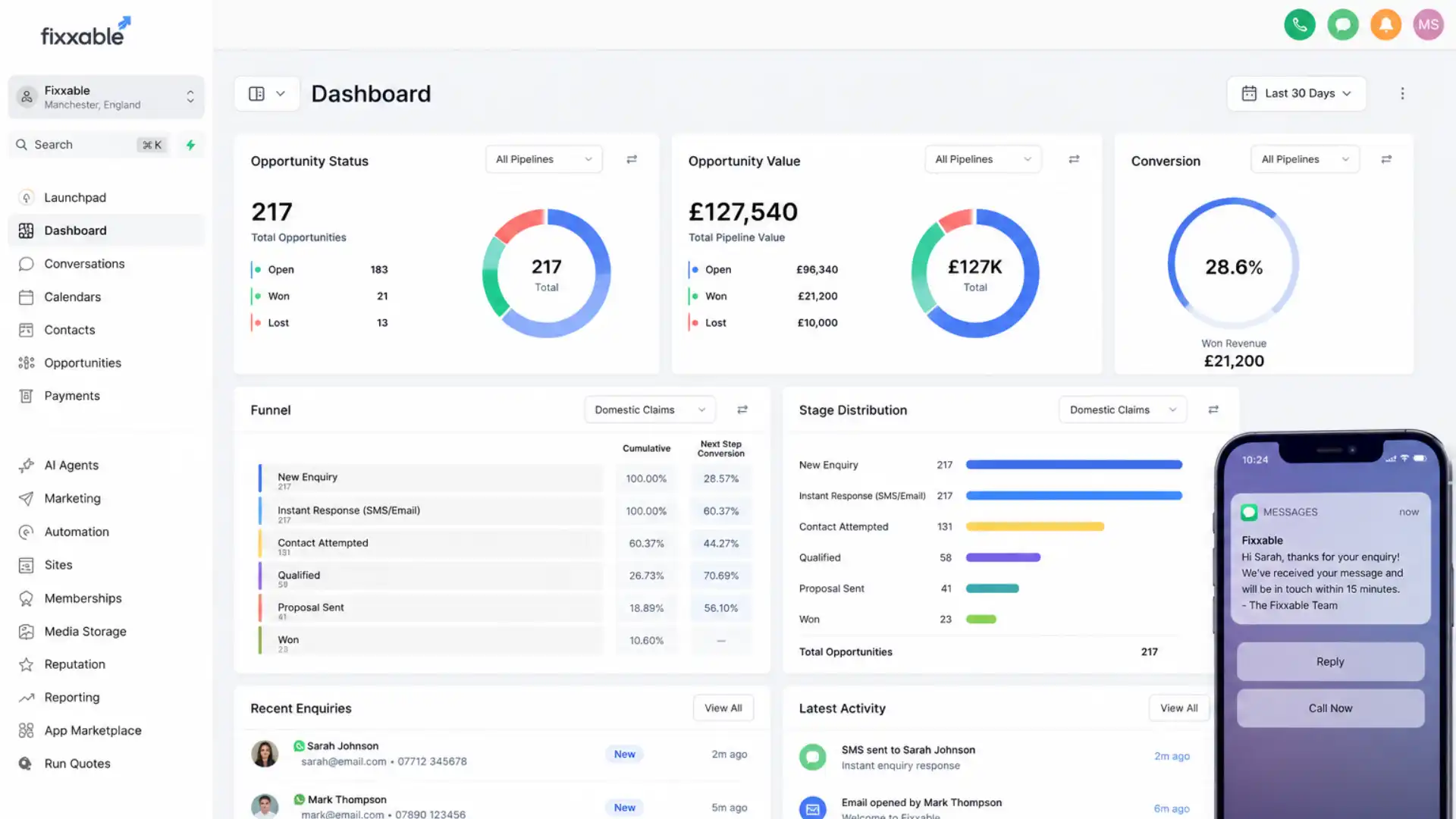
How to follow up with a website enquiry before your competitor does
Every website enquiry follow up is a race you may not realise you’re in. The moment someone fills in your web form, they almost certainly fill in someone else’s too. And research shows the business that responds first wins the majority of the time — not the cheapest, not the most experienced, but the fastest.
This guide gives you the data behind lead response time and a practical business automation blueprint you can put in place today — so your next website enquiry gets a response in minutes, not hours.
78% of customers buy from the first business to respond to their enquiry
The speed-to-lead reality most businesses ignore
Most small businesses think they respond to enquiries reasonably quickly. The data tells a different story. Industry research consistently shows the average lead response time across businesses is well over 24 hours. One large study of more than 1,000 companies found the average was nearly 29 hours — and over 63% of businesses did not respond at all.
Here is what that delay actually costs you:
- Respond within 5 minutes: you are 100 times more likely to make contact with that lead than if you wait 30 minutes
- Wait just 10 minutes: your chance of qualifying that prospect drops by four times compared to a 5-minute response
- Wait an hour: you are 60 times less likely to qualify the lead than if you’d responded immediately
- Wait 24+ hours: the vast majority of those leads have already chosen someone else
These are not theoretical numbers. They come from studies involving hundreds of thousands of leads across industries. The pattern is consistent: every minute of delay in your website enquiry follow up reduces your chances of winning that customer.
100x more likely to make contact if you respond within 5 minutes vs 30 minutes.
Why most small businesses are slow to respond
Slow website enquiry follow up is rarely deliberate. It happens because of how most businesses are set up — not because of a lack of intention.
Enquiries land in a shared inbox nobody owns
If website form submissions arrive in a general email address, they sit there until someone happens to check it. In a busy working day, that could be hours. If the person who usually handles it is out, it could be days.
There is no process for out-of-hours enquiries
A significant portion of website enquiries arrive in the evening and at weekends — exactly when no one is in the office. Without business automation, those leads wait until the next working day. By then, a competitor who was set up to respond automatically has already made contact.
Follow-up depends on people remembering
Manual lead response time relies entirely on individuals remembering to act. A new enquiry comes in, someone means to call back, and then a job runs over, a phone rings, and the follow-up gets pushed. Without an automated trigger, nothing happens until someone actively remembers.
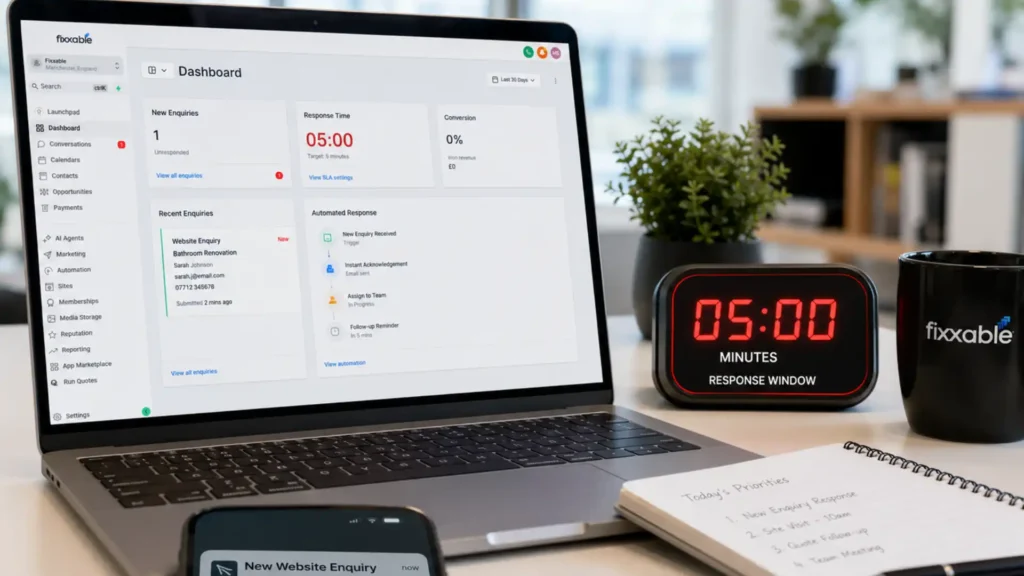
Want to see how instant follow-up works in practice?
Fixxable is built to automate your website enquiry follow up from the moment a form is submitted. Book a free demo and we'll show you exactly how to set it up for your type of business — no tech skills required.
The automation blueprint: how to respond in under 5 minutes, every time
The only reliable way to achieve consistently fast website enquiry follow up is to automate the first response. Here is a practical step-by-step blueprint you can implement with the right business automation platform.
Step 1: Instant acknowledgement — within seconds
The moment a form is submitted on your website, an automated message goes out immediately. This can be an email, an SMS, or both. It does not need to be long — it just needs to arrive fast.
A good instant acknowledgement does three things: it confirms you received the enquiry, sets an expectation for when you will be in touch, and reassures the prospect they have come to the right place. This alone sets you apart from the majority of competitors who send nothing.
Fixxable’s SMS and WhatsApp automation handles this automatically — the message is triggered by the form submission without any manual action required.
Step 2: Qualified notification to your team — within 1 minute
At the same time, the right person on your team gets an instant notification: a push alert, an SMS, or a message in whatever tool they use. Not a general inbox — the right person, right now.
This is where a CRM system earns its place. The enquiry lands in the CRM as a new lead, visible to whoever needs to see it, with all the submitted information already captured. No copying from email, no risk of it being missed.
Step 3: AI or chatbot first contact — if your team is unavailable
For out-of-hours enquiries, an AI chat bot or voice agent can engage the prospect immediately. It can answer common questions, qualify the enquiry, and even book an appointment — all without a human being present.
Fixxable’s voice agents and missed call text back ensure that even when your team is off the clock, a prospect never hits a wall of silence. They get a response. That response keeps them on your side of the decision.
Step 4: Automated follow-up sequence — days 1 to 7
Not every lead converts on the first contact. Research consistently shows that most sales require multiple follow-up touchpoints — yet most businesses give up after one or two attempts. An automated sequence removes that risk.
Here is a simple follow-up cadence you can automate:
- Day 1 (within 5 minutes): instant SMS/email acknowledgement
- Day 1 (within 1 hour): personal phone call from your team, prompted by CRM notification
- Day 2: automated follow-up email with a relevant case study or service overview
- Day 4: second SMS or WhatsApp message with a clear call to action
- Day 7: final follow-up with an offer to book a call or appointment
This entire sequence can be set up once in Fixxable and run automatically for every new website enquiry follow up — without your team manually tracking who has and hasn’t been contacted.
What good follow-up looks like — and what to avoid
Speed gets you in the door. Quality keeps the conversation going. Here is what separates a website enquiry follow up that converts from one that gets ignored:
Do: personalise even your automated messages
An automated response does not have to feel robotic. Use the prospect’s name. Reference what they enquired about. A message that says “Hi Sarah, thanks for getting in touch about our kitchen fitting service” lands very differently to a generic “We’ve received your message.”
Do: use the right channel for the right message
SMS gets opened far faster than email — open rates for text messages are consistently above 90%. For an urgent first response, SMS or WhatsApp is more effective than email. For longer messages, proposals, or documentation, email still wins. Use both, in the right sequence.
Do not: send a "just checking in" email
Every follow-up after the first should bring something of value — a relevant example, an answer to a likely question, or a reason to take the next step. Generic “just checking in” messages get ignored and can actually damage the impression you made with a fast initial response.
Do not: give up after one attempt
The average salesperson gives up after one or two attempts. The research on lead response time is clear: persistence, paired with value, is what converts a prospect who did not respond immediately. An automated sequence means you never forget to follow up — and you never give up too soon.
How to measure whether your follow-up is working
Improving your website enquiry follow up is only useful if you can track whether it is working. The key metrics to watch are:
- Average lead response time: how long between form submission and first contact? Aim for under 5 minutes for automated messages, under 1 hour for a personal call
- Contact rate: what percentage of enquiries do you actually make contact with? If it is below 80%, something in your process is failing
- Enquiry-to-quote rate: how many web enquiries turn into actual quotes or proposals? A drop here often signals a follow-up quality problem, not a speed problem
- Conversion rate by response time: split your leads into response time buckets (under 5 min, 5–60 min, 1+ hours) and compare conversion rates — the difference will likely surprise you
A proper CRM and tracking setup surfaces all of this automatically. Without it, you are guessing.
For further background on digital tools designed for UK small businesses, the UK Government’s Business Finance Guide covers digital adoption as part of a broader growth strategy. [OUTBOUND LINK: UK Government’s Business Finance Guide
Ready to stop losing leads to a slower competitor?
Fixxable's business automation platform is built to make instant website enquiry follow up the standard for your business — not the exception. From automated SMS responses and AI chat to a full CRM with follow-up sequences, everything you need is in one place. Set it up once. Win more enquiries from then on.